optimization-lab
Applied mathematical optimization, from first principles
Welcome
Optimization is the mathematics of choosing the best option: the parameters that fit data best, the controls that steer a system most cheaply, the allocation that does the most with a fixed budget. Almost every quantitative field relies on it, and most people who use it meet it through a library call, a learning rate, a solver that converged or did not. This book is about what happens inside that call: how the main families of optimization algorithms work, why they work, what each assumes about the problem, and how they fail.
Its organizing idea is that every method makes a bet about what is worth measuring. A gradient method bets on the local slope; Newton’s method on curvature; the simplex method on the corners of a polyhedron; a barrier method on staying strictly inside the constraints; a genetic algorithm on a population exploring in parallel; Bayesian optimization on a statistical model of the objective. Each bet pays off on some problems and fails on others, and the shape of the problem (its smoothness, its convexity, its conditioning, its constraints, its dimension) decides which.
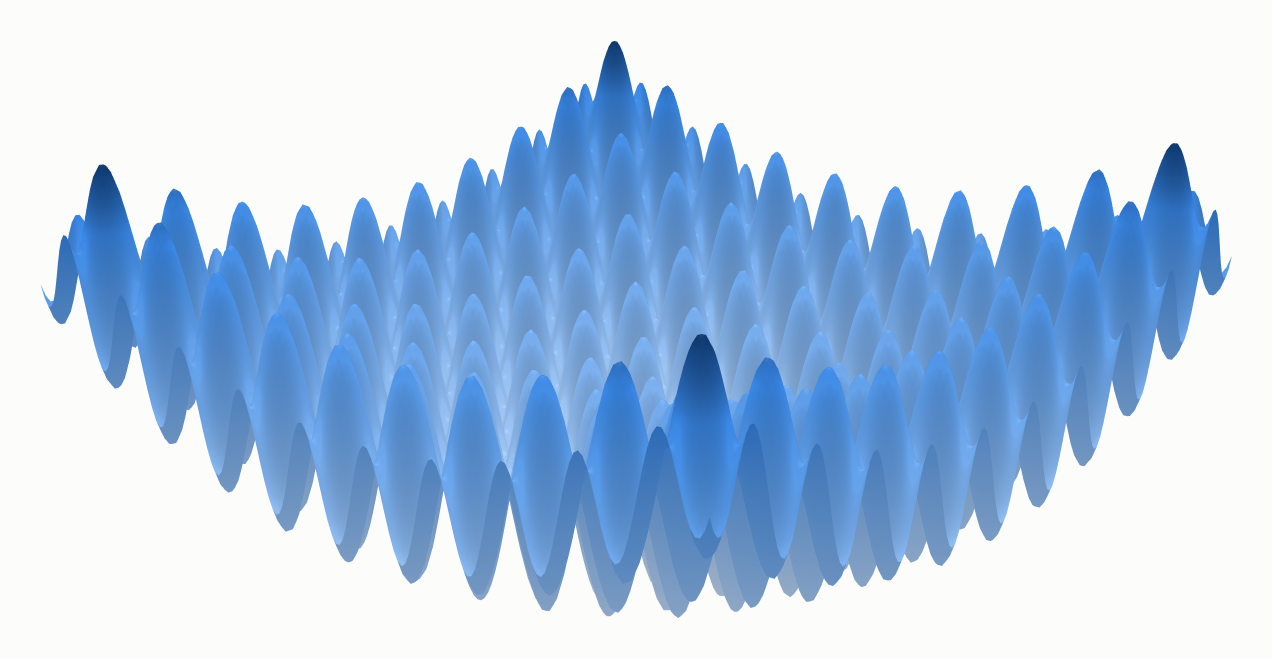
Three commitments shape the book:
- Mechanism first. Every method is presented with its update rule, the one derivation step that makes it work, the settings that matter, and the ways it fails, so that it can be understood without reading any code.
- Every figure is computed. Each plot and each number on these pages is produced at build time by a from-scratch implementation of the method it illustrates, and checked against independent solvers where one exists. The code is folded away by default; Show the code above any figure reveals how it was made.
- Honest scope. The examples are small enough to see. Each chapter ends by saying what its small examples cannot show.
How this book is organized
The map shows the whole book on one page, with reading paths. Part I, Foundations, describes the geometry of an objective (slope, curvature, conditioning, convexity) and the gradient and curvature methods built on it. Part II, Convex workhorses, covers linear programming, least squares and regularization, and constraints and duality: the problem classes with exact answers and strong guarantees. Part III, Beyond convex and smooth, drops those assumptions: derivative-free and global search, estimation from data, and the high-dimensional non-convex landscapes of neural networks. Part IV applies all of it to problems from imaging, physics, control, machine learning, economics and resource allocation. The appendices hold a guide to choosing an algorithm, the notation, a note on the code behind the figures, and further reading.
What you need
Multivariable calculus (gradients, the chain rule, Taylor expansions), linear algebra (matrices, eigenvalues, orthogonality) and basic probability (Gaussian distributions, expectations). No prior optimization is assumed.