1 The Map
“Map of mathematics” videos are a genuinely useful genre — and they share a flaw. They draw one tree, with arithmetic at the root and category theory somewhere near the leaves, and that tree quietly answers three different questions at once: when was this idea discovered, what does it formally rest on, and what should you learn first. Those are three different graphs. They mostly agree, which is exactly what makes it easy to stop noticing when they don’t — and the times they don’t are usually the most interesting fact about the idea in question.
This chapter is the map: four orderings that get conflated if you’re not careful, and the master diagram — built from the second half of that list, the ones that actually organize this site — that the rest of the book hangs off of.
1.1 Four maps, not one
Historical development — when an idea actually first appeared, in whatever form. Approximate, contested in places, and simplified below; treat every date as “roughly.”
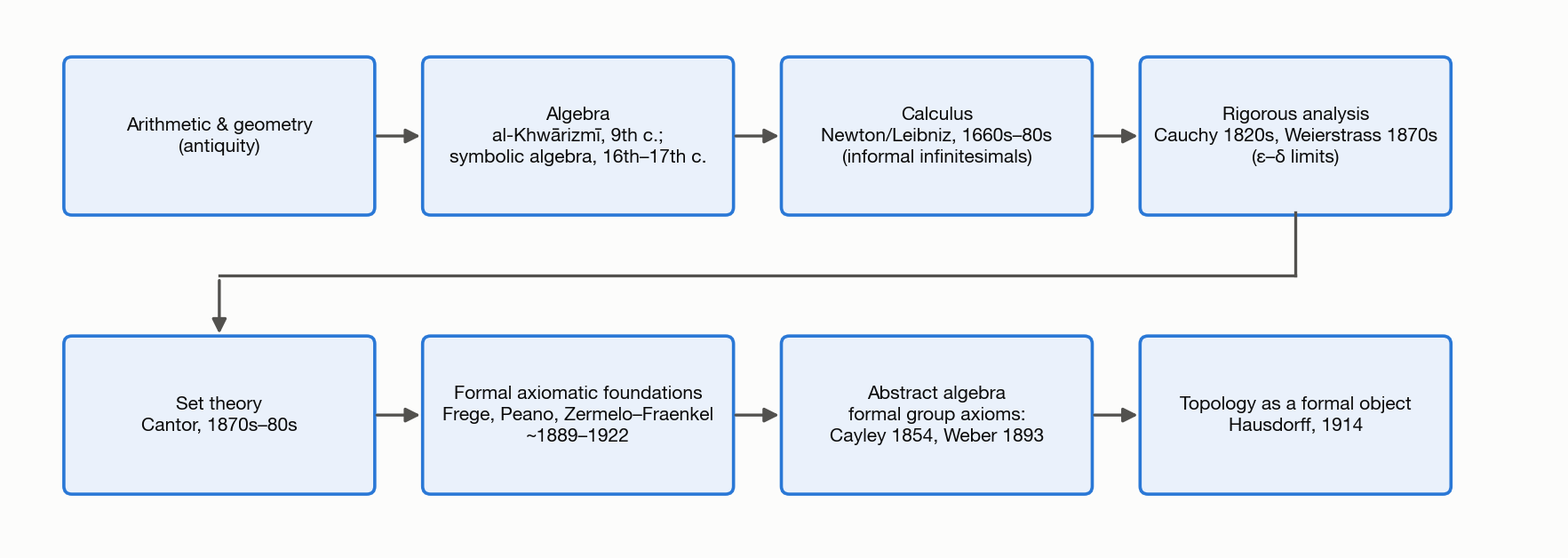
The gap between C and D is the one worth sitting with: calculus is roughly two centuries older than the rigorous theory of limits it’s now formally built on, and about the same distance older than the set theory that formally underlies that. Newton and Leibniz got correct answers using infinitesimals nobody could yet justify.
Formal/logical foundations — how mathematics is built up today, if you start from axiomatic set theory and add machinery one layer at a time.
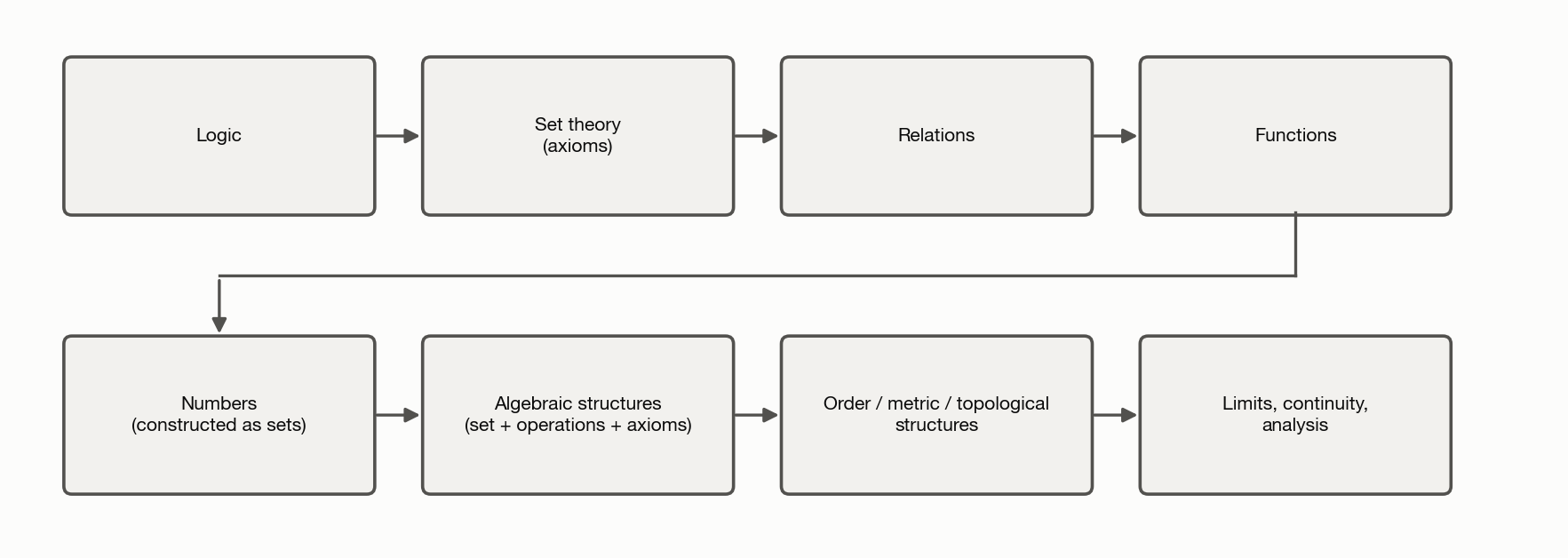
Conceptual dependency — what you need to understand, not formally construct, before an idea makes sense. Much sparser than the formal graph: grasping a group needs “a set with a binary operation,” full stop — not a Zermelo–Fraenkel construction of the natural numbers underneath it.
Pedagogical ordering — the sequence that actually motivates learning best, which deliberately violates the formal graph when doing so helps: this site shows \(\mathbb{R}^n\) before the abstract vector-space axioms even though, formally, \(\mathbb{R}^n\) presupposes more machinery than the axioms alone do.
A few concepts, placed on all four at once, make the gaps concrete:
| Concept | Historical origin | Formal foundation | Conceptual prerequisite | Where this site teaches it |
|---|---|---|---|---|
| Sets | Cantor, 1870s–80s | Axioms of ZFC | Almost none — “a collection of things” | Sets |
| Groups | Implicit in Galois’s work on equations, 1830s; axioms formalized by Cayley (1854)/Weber (1893) | A set with one operation satisfying four axioms | Set + binary operation | Groups |
| Vector spaces | Peano’s axioms, 1888 — after \(\mathbb{R}^n\), matrices, and polynomials were all already in wide use | A set over a field with two operations satisfying eight axioms | Group (for addition) + a notion of scaling | Vector Spaces |
| Limits / calculus | Newton & Leibniz, 1660s–80s, informally | Built from the topology of \(\mathbb{R}\) | Function + a notion of “arbitrarily close” | Limits and Continuity |
Notice the direction of the gap is not always the same: sets are historically recent but conceptually nearly free; calculus is historically ancient (by mathematical standards) but formally late, resting on machinery invented to justify it after the fact. Whenever this site says “this came before that,” the table above is the implicit question: before in which sense?
1.2 The master map
The diagram below is this site’s actual spine — the chapters that exist today, plus a few later ones drawn hollow so the shape of the whole graph is visible even where the content isn’t written yet. Two dozen-plus edges is too many to individually label on a diagram this size without recreating the exact clutter this figure is replacing, so read edge direction as pointing toward the more-built-up idea — every edge in the current graph is a forward relationship. Where an arrow crosses between colors it is doing one of three things: carrying a conceptual prerequisite (third row of the table above — e.g. Number Systems into What Is a Structure?), an abstraction relationship in the sense of that same chapter (What Is a Structure? into Groups, Rings and Fields, and Vector Spaces; Vector Spaces into Inner Product Spaces and Affine Spaces), or an application pulling an idea in from outside pure mathematics (Linear Algebra and Differential Equations into Machine Learning and Physics). This is a map, not a dependency proof — some edges could legitimately be drawn elsewhere, and that’s a feature of a graph, not a bug to fix by turning it into a tree.
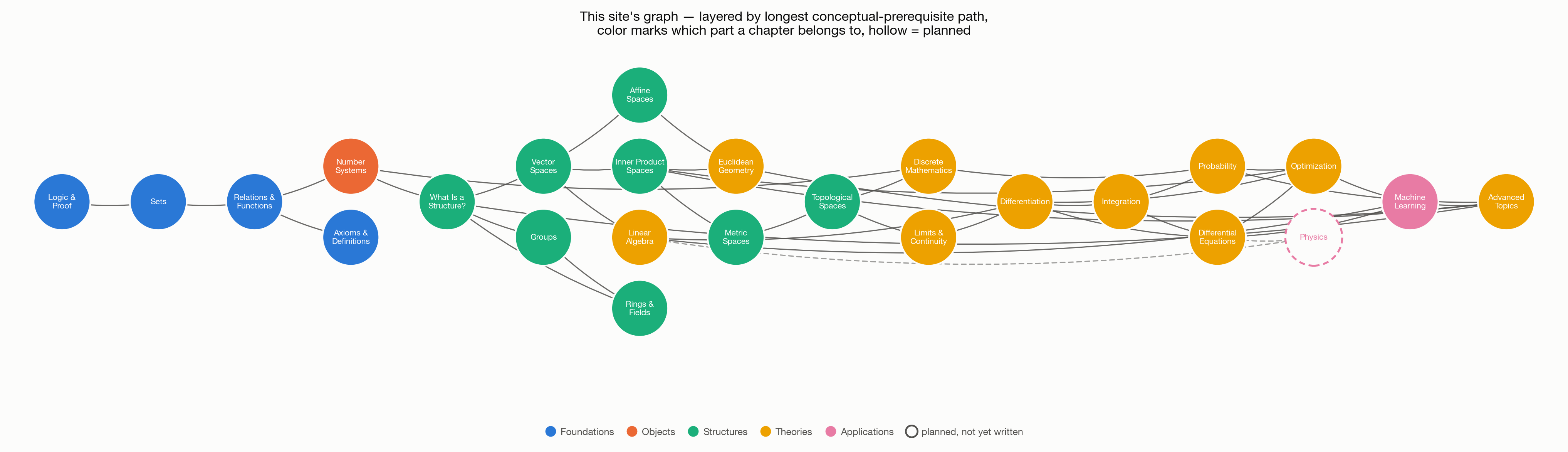
scripts/figures/fig_landscape_network.py) rather than the Mermaid version this replaced, whose dark subgraph fill and edge routing broke against this site’s light theme. Solid, filled, white-labeled nodes are chapters that exist; hollow, dashed-outline nodes (Machine Learning, Physics) are planned — dashed edges mark a connection into one of those planned nodes, not a different kind of relationship. Every edge is a forward conceptual-prerequisite, abstraction, or application relationship, per the paragraph above.
1.3 Two ways in
Top-down, from bedrock — the order in the table of contents: Logic → Sets → Relations & Functions → Axioms & Definitions → Number Systems → What Is a Structure? → Groups / Vector Spaces → Linear Algebra.
Bottom-up, from something you already use — the mirror image. An ML practitioner who writes embedding_matrix @ x and wants to know what world that equation actually lives in reads Machine Learning → Linear Algebra → Vector Spaces → What Is a Structure? and stops once the ground feels solid — not necessarily all the way back to Logic. Neither direction is more correct; they’re the same graph traversed in opposite order, which is the whole point of building this as a graph rather than a syllabus.
1.4 Six threads that keep coming back
A handful of ideas recur across nearly every chapter under different names. Naming them once here means later chapters can just point back:
- Generalization — \(\mathbb{N} \to \mathbb{Z} \to \mathbb{Q} \to \mathbb{R} \to \mathbb{C}\); \(\mathbb{R}^n \to\) vector space \(\to\) inner-product space \(\to\) metric space. Every step gains something and loses something, and naming both sides of that trade is more useful than just naming the gain.
- Structure over identity — mathematicians increasingly care less about what an object “is” and more about what operations it supports. A polynomial, a matrix, and a function can all be vectors; see What Is a Mathematical Structure?
- Invariance — what stays true under a transformation. This is the thread connecting symmetry, group theory, linear algebra, geometry, and (later) physics.
- Transformation — functions, then linear maps, then differentiable maps, then continuous maps: successively looser notions of “structure preserving.”
- Approximation — a limit is already an infinite sequence of approximations agreed to converge; Taylor approximation builds successively better polynomial stand-ins for a function; Euler’s method approximates a differential equation’s solution one small step at a time; gradient descent approximates a function’s minimum the same way, and training a model is that same process at scale. Underneath most of this site’s later, more computational chapters is some version of “replace an exact but intractable answer with a sequence of tractable ones that provably get close enough.”
- Local vs. global — a derivative is a local fact about a function; a basis is a global fact about a vector space. The distinction resurfaces in every branch this site eventually reaches.
What Is Mathematics?, next, picks up the thread from here with the question underneath all of this: what is mathematics, actually, if not a pile of courses?