The Map
This book makes one argument in twelve chapters, and it helps to see the whole of it before starting. Three pictures carry it: the space in which every learning problem and every method sits, the lineage that connects the methods, and the handful of independent choices that every method name hides.
The space: what the feedback says, and who generated the data
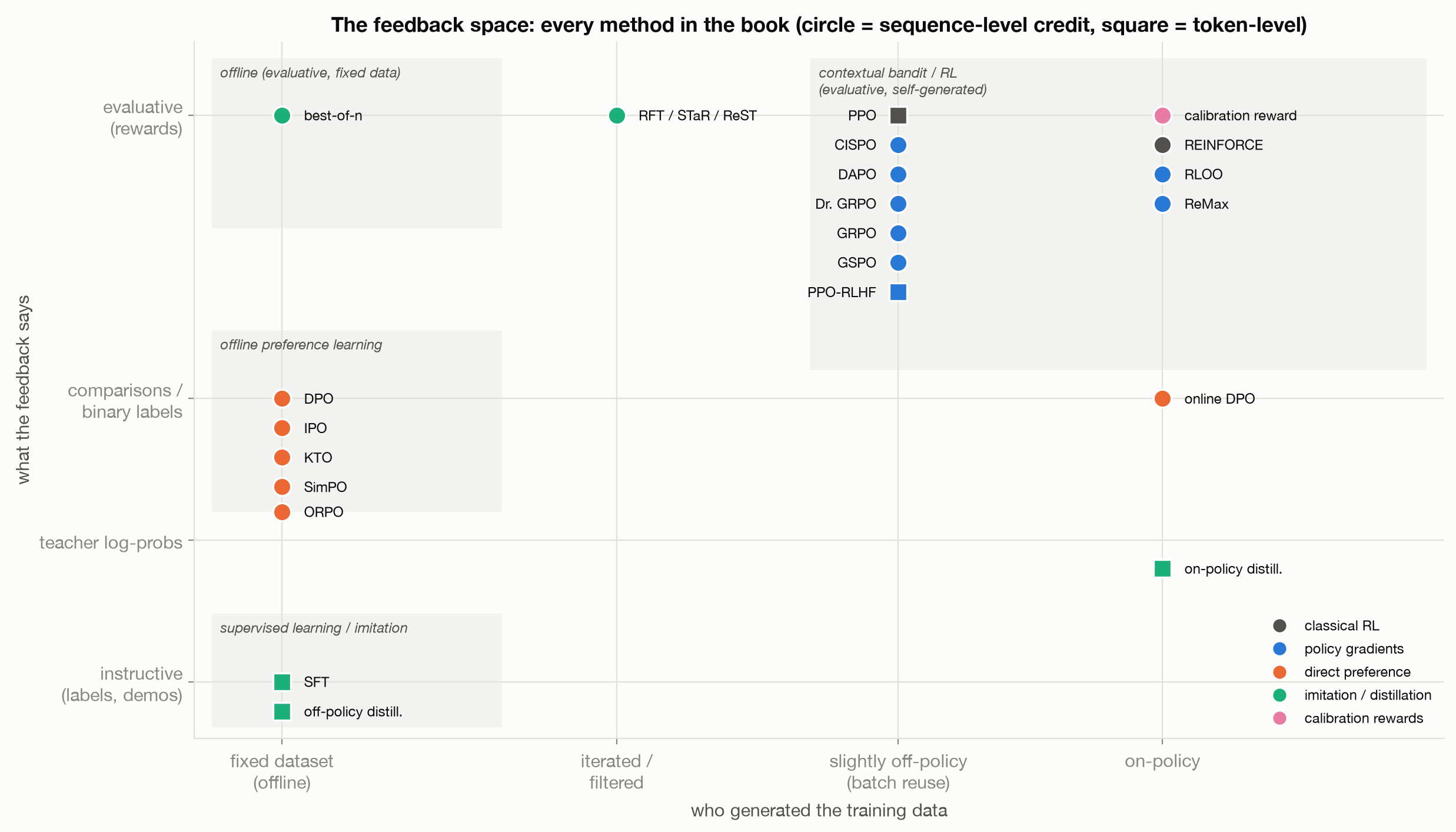
Supervised learning and reinforcement learning are not two kinds of machine learning. They are regions of one space (What Makes a Problem RL). Along one axis, the feedback is instructive (a label says what the right answer was) or evaluative (a reward says only how good the given answer was), with comparisons and teacher signals in between. Along the other, the data is a fixed dataset or is generated by the learner’s own policy. A third axis, not shown as a position, is whether credit arrives immediately or must be assigned across a sequence of actions.
The lineage: one tree, a few branches
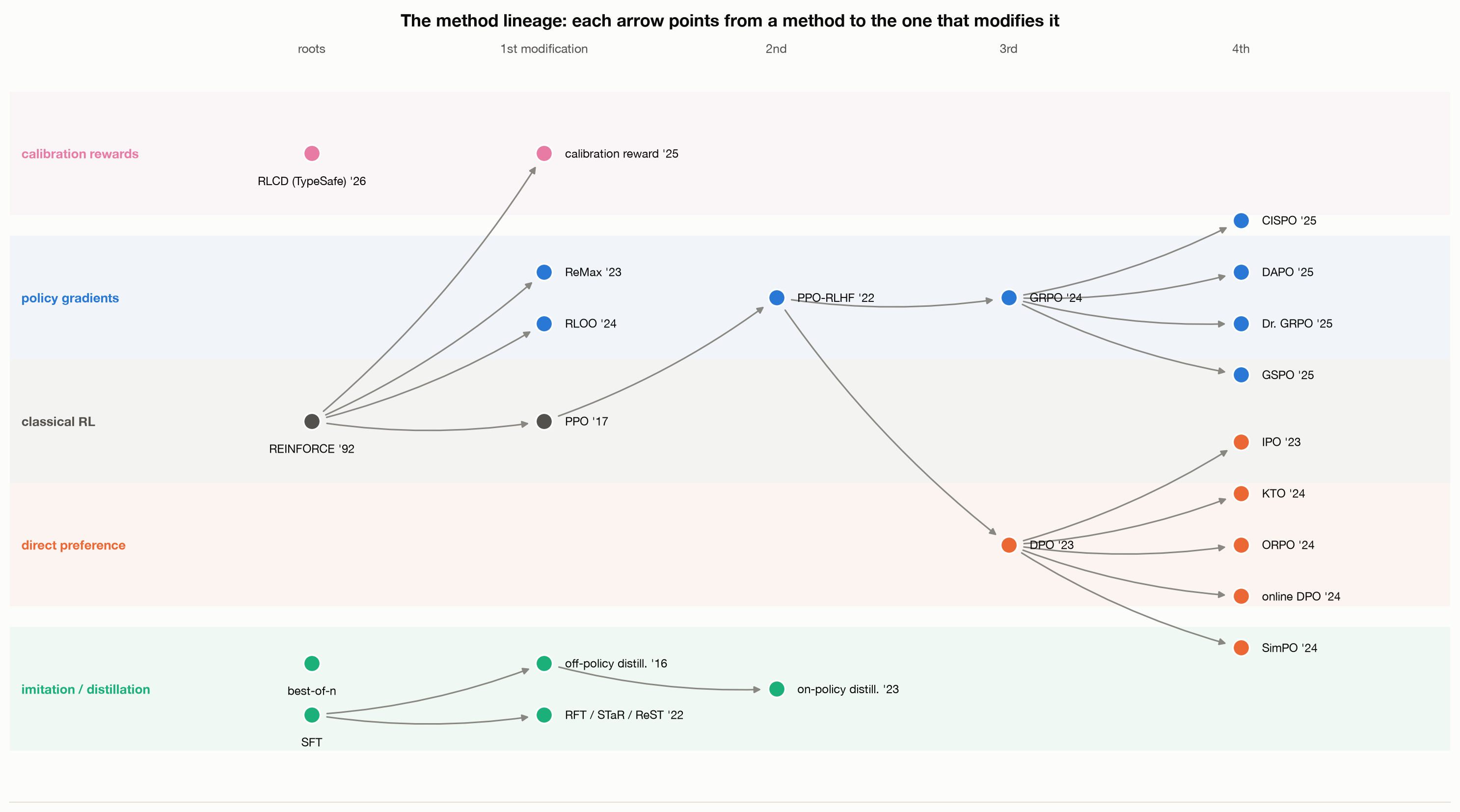
Almost every named method modifies an earlier one, usually in exactly one respect. The tree grows from two main roots, the policy gradient (REINFORCE) and behavior cloning (SFT). From REINFORCE come PPO and PPO-based RLHF, which branches into the direct preference methods and GRPO’s line of critic-free policy gradients; the other critic-free methods (RLOO, ReMax) and the calibration reward modify REINFORCE directly. Filtered imitation and distillation grow from SFT. Two methods stand alone: best-of-\(n\) sampling, which modifies no training method, and TypeSafe’s RLCD, whose lineage is undisclosed.
Each node links to a chapter:
| Family | Methods | Chapter |
|---|---|---|
| classical RL | REINFORCE, PPO | Policy Gradients, Keeping Updates Stable |
| the hub | the KL-regularized objective, \(\pi^\star\), PPO-based RLHF | The Shared Target, and RLHF with PPO |
| direct preference | DPO, online DPO, IPO, KTO, SimPO, ORPO | Direct Preference Methods |
| critic-free policy gradients | RLOO, ReMax, GRPO, Dr. GRPO, DAPO, GSPO, CISPO | Policy Gradients Without a Critic |
| imitation and distillation | SFT, best-of-\(n\), rejection-sampling fine-tuning, STaR, ReST, RAFT, off- and on-policy distillation | Learning by Imitating a Better Distribution |
| calibration rewards | correctness + proper scoring rule; RLCD | Rewarding Calibration |
| where it is heading | multi-turn and agentic RL | What RL Actually Does to a Model |
The axes a method name hides
A method name bundles several independent choices. The book unbundles them into the same fields for every method, its method card, and the unified table lines them up.
| Axis | The choices | Where it is derived |
|---|---|---|
| Signal source | demonstrations · pairwise preferences · binary desirability · learned scalar reward · verifiable reward · AI or judge feedback · teacher log-probabilities · a scored probability | rewards, calibration |
| Data regime (\(q\)) | offline · on-policy · slightly off-policy (batch reuse) · iterated | what makes a problem RL, stable updates |
| Estimator and weight (\(w\)) | maximum likelihood · pairwise logistic likelihood · policy gradient with no baseline, a critic, leave-one-out, or group mean and std | policy gradients, critic-free |
| Stability | KL in the reward · KL in the loss · clip / trust region · reference-free · entropy bonus | stable updates |
| Credit granularity | sequence · token · step (process rewards) | the LLM as a policy |
| Models in memory | policy · reference · reward model · critic · teacher | the shared target |
Reading paths
Front to back is the intended order: each part makes the next one feel inevitable. Three shorter paths also work. If you know classical RL and want the LLM-specific part, start at The LLM as a Policy. If you want the single idea that unifies the methods, read Policy Gradients and then The Shared Target. If you have a new paper in hand, go to the five-minute recipe in the decision guide.