10 Rewarding Calibration: RLCD and Proper Scoring Rules
Every reward in the book so far scores the answer. A preference model scores how much raters like it; a verifier scores whether it is right. Neither asks the model how sure it is, and neither rewards it for knowing. In September 2026 TypeSafe AI announced a training method named for that missing target, Reinforcement Learning for Calibrated Decisions (RLCD), for a model, Jev, that returns typed decisions with probabilities. Only the name and the goal of RLCD are public. This chapter is therefore built in three visibly separate layers: what was disclosed, stated and dated; a first-principles reconstruction of what rewarding calibration means as RL, which is this book’s own analysis and not TypeSafe’s algorithm; and the openly published research on the same objective. The reconstruction is where the RL content is. It shows why a correctness reward pushes a model toward confident guessing, why a proper scoring rule makes honest probabilities optimal, and why the answer and the confidence cannot be rewarded separately.
10.1 Layer 1: what was disclosed
As of 1 October 2026, the primary source is TypeSafe AI’s announcement, “Introducing System One Models & Jev”, dated 15 September 2026 (TypeSafe AI 2026). It describes “a new stack entirely focused on automation: with a new model architecture, parallel sampler for maximum efficiency, and training method we call Reinforcement Learning for Calibrated Decisions (RLCD)”. It contrasts RLCD’s objective with RLHF’s (“human preference”) and RLVR’s (“outputs that can be programmatically verified”): RLCD optimizes for “calibrated decisions: answers with epistemically honest probabilities on System One tasks”. Jev returns “type-safe structured values”, with “all answers … accompanied with calibrated probabilities and confidence scores”, and “outputs all probabilities in parallel instead of autoregressively generating by token” (TypeSafe AI 2026).
The announcement does not disclose the training algorithm, the reward function or the architecture. Its FAQ says that Jev “is neither small nor an LLM”, that on training data “We make all the data ourselves” (“if you want to find out more, we’d have to hire you”), and that TypeSafe “deliberately chose not to publish performance against public benchmarks” (TypeSafe AI 2026). Its performance claims are the vendor’s: end-to-end responses in “70ms-500ms”, “40x-200x faster for the same levels of frontier intelligence for System One shaped queries”, input tokens at “$0.042 / MTok” with output tokens “FREE”, a model that “can’t hallucinate” and “never makes type errors”, and workflow comparisons of “193.6x faster, 444.6x cheaper”. The post itself adds caveats: “Extraordinary claims require extraordinary evidence”, the LLM comparison numbers come from OpenRouter where routing “almost certainly” biases them, and “we can’t prove it isn’t subsidized” (TypeSafe AI 2026). None of these claims has been independently verified beyond the evaluation below.
One independent evaluation exists. Guo et al. benchmark Jev as a zero-shot detector of ten alignment failures across 44 benchmarks and report a median AUROC of 0.886 with a single generic question, beating supervised baselines on most benchmarks at 63× lower cost than LLM-judge scorers (Guo et al. 2026). It does not describe RLCD’s mechanism. Its calibration findings are the part that bears on this chapter, and they are more nuanced than “calibrated”: “Jev’s probabilities are calibrated when pooled but not within a benchmark.” Pooled, the reliability curve is “close to the diagonal (ECE 0.047)”; per benchmark, “median per-benchmark ECE … is 0.168 against 0.074 under perfect calibration, and 24 of 31 benchmarks exceed the null’s 95th percentile”. The error is “a base-rate mismatch, not a ranking problem”: Jev’s mean probability misses a benchmark’s positive rate by a median of 0.125 while ranking well (median AUROC 0.905) (Guo et al. 2026). Calibration is a property of a model on a distribution, and one evaluation can show it holding in aggregate and failing within most slices.
| Signal | “calibrated decisions: answers with epistemically honest probabilities” (the objective is public; the reward is undisclosed) |
| Samples from (\(q\)) | undisclosed |
| Per-sample weight (\(w\)) | undisclosed |
| Stability | undisclosed |
| Credit granularity | undisclosed (outputs are typed decisions with probabilities, produced “in parallel”, not token by token) |
| Models in memory | undisclosed |
| Targets | calibrated probabilities over typed answers (stated goal) |
| Classical lineage | undisclosed; see the reconstruction below for what the stated goal implies |
10.2 Layer 2: a first-principles reconstruction
Everything in this section is this book’s analysis of what it means to reward calibration with RL. It is built from public theory (proper scoring rules) and checked on the toy language. It is not a description of how TypeSafe trains Jev, which has not been published.
The problem with a correctness reward
Start from RLVR: reward \(r = \mathbb{1}[\text{correct}]\). If the policy can answer or abstain, abstaining earns 0 and answering earns \(P(\text{correct})\) in expectation, so answering is better whenever that probability is above zero. A binary correctness reward never rewards “I’m not sure”. Wu et al. put it exactly: standard RLVR paradigms “inadvertently incentivize models to function as ‘good test-takers’ rather than ‘honest communicators’, encouraging guessing whenever the probability of correctness exceeds zero” (Wu et al. 2025). And if the policy states a confidence alongside its answer, a correctness reward is indifferent to it: nothing in the gradient touches the confidence, so it stays wherever pretraining put it.
Rewarding the stated probability with a proper scoring rule
Let the policy output an answer \(a\) and a confidence \(p\) that \(a\) is correct, and let \(o = \mathbb{1}[a \text{ correct}]\). Reward the confidence with a scoring rule \(S(p, o)\). If \(S\) is proper, then for a fixed answer whose true probability of being right is \(\eta\), the expected score \(\mathbb{E}_{o\sim\text{Bernoulli}(\eta)}[S(p,o)]\) is maximized by reporting \(p = \eta\): honesty is optimal. The negative Brier score \(-(p-o)^2\) and the log score are both strictly proper. The theory of proper scoring rules is in loss-functions-lab’s decision-theory chapter and in Gneiting and Raftery (Gneiting and Raftery 2007); for the Brier score the check is one line, \(\mathbb{E}[-(p-o)^2] = -\big(\eta(1-p)^2 + (1-\eta)p^2\big)\), whose derivative in \(p\) vanishes at \(p = \eta\).
Three points make this an RL problem rather than ordinary calibration.
The label depends on the policy. The thing the confidence must predict is whether the model’s own answer is right. Change the policy’s answers and the right confidence changes. The feedback is evaluative and the data self-generated, the two properties of the first chapter. Post-hoc calibration on a fixed dataset of someone else’s answers cannot express this.
The answer and the confidence interact. Reward the confidence alone with the Brier score and the expected reward of an answer with success probability \(\eta\), reported honestly, is \(-\eta(1-\eta)\). That is highest at \(\eta = 0\) or \(\eta = 1\): the score rewards answers whose outcome is predictable, including answers that are predictably wrong. Add the correctness term, \(r = o - (p - o)^2\), and the expected reward of an honestly reported answer is \(\eta - \eta(1-\eta) = \eta^2\), increasing in \(\eta\): the policy should give its best answer and its honest probability of being right.
\[ r(a, p) = \mathbb{1}[a \text{ correct}] + S(p, \mathbb{1}[a\text{ correct}]),\qquad S(p,o) = -(p - o)^2, \] whose expected value for an answer with success probability \(\eta\) is maximized by the best available answer and \(p = \eta\) (expected value \(\eta^2\) at the optimum).
Damani et al. state the general condition: with a correctness term of weight \(c_{\text{corr}}\) (their \(\lambda\)), a proper scoring rule keeps both incentives as long as it is bounded, \(S(p,1) - S(p,0) < c_{\text{corr}}\); an unbounded rule like the log score can make “incorrect answers with zero confidence” optimal (Damani et al. 2025).
One decision, an immediate outcome: a contextual bandit. For a single typed decision whose outcome is known right away, there is no sequence of states to assign credit across. This is the contextual bandit of the first chapter, not a long-horizon MDP, and the policy gradient of the policy-gradient chapter with a group baseline is all the machinery needed.
The decision problem is Sutton and Barto’s associative search: one action per context, an immediate outcome. The reward is a proper scoring rule, the device weather forecasting has used since Brier to make honest probability reports optimal. RL contributes the part forecasting did not need: the event being forecast is the outcome of the learner’s own action.
Abstention then falls out. With calibrated probabilities, a decision rule can answer only when the stated probability clears a threshold set by the cost of a wrong answer. With uncalibrated ones, the same rule is meaningless.
| Signal | the outcome of the policy’s own answer, scored by \(\mathbb{1}[\text{correct}] - (p - \mathbb{1}[\text{correct}])^2\) |
| Samples from (\(q\)) | \(\pi_\theta\): several (answer, confidence) samples per prompt (on-policy) |
| Per-sample weight (\(w\)) | the reward minus a leave-one-out baseline |
| Stability | none beyond a small learning rate in the toy; a KL to \(\pi_{\text{ref}}\) is optional |
| Credit granularity | one decision, one immediate outcome (contextual bandit) |
| Models in memory | policy (+ a verifier for the outcome) |
| Targets | the best answer per prompt, with stated probability equal to its success rate |
| Classical lineage | a contextual bandit trained by REINFORCE with a Monte Carlo baseline; the reward is a proper scoring rule from forecasting |
Checked on the toy language
The toy version (rl4llm/calibration.py) makes a response an answer (three tokens) followed by a stated confidence (the last token, one of 0.1, 0.3, 0.5, 0.7, 0.9). Each answer succeeds at random with a hidden probability, so there is real uncertainty the model cannot resolve. The prompts range from hard (the best answer is right 23% of the time) to easy (96%), and the reference policy is overconfident, putting most of its mass on “0.9”. The policy is trained by RLOO with three rewards, and everything in Figure 10.1 is computed exactly under the trained policies.
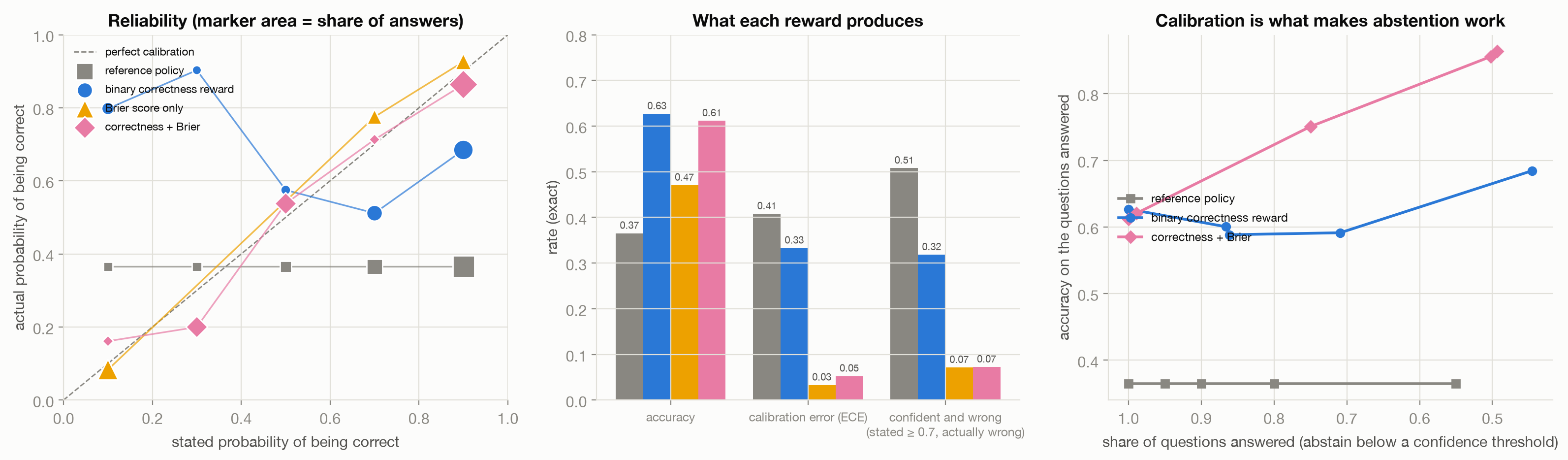
The three rewards do what the analysis predicts. The binary reward raises accuracy from 0.37 to 0.63 (the best achievable is 0.65) and leaves the stated confidence uninformative: its reliability curve is flat, its calibration error is 0.33, and 32% of all its answers are stated with confidence of at least 0.7 and wrong. The Brier score alone is the best calibrated (ECE 0.03), but its accuracy falls to 0.47, because on the hard prompts it learns to give answers that are almost surely wrong and say “0.1” (the exact optimum of the Brier-only reward is a surely-wrong answer on three of the four prompts). Correctness plus Brier keeps accuracy at 0.61, is calibrated (ECE 0.05), and cuts the confident-wrong rate from 32% to 7%. The right panel shows why calibration is worth having. Abstaining below a confidence threshold raises the calibrated policy’s accuracy from 0.61 to 0.86 on the half of the questions it answers; the binary-reward policy’s confidence carries so little information that the same rule only lifts its accuracy from 0.63 to 0.68 at a similar coverage.
10.3 Layer 3: public research on rewarding calibration
Several openly published methods reward calibration with RL. None of them is TypeSafe’s method, and the list reflects what was found by search as of 1 October 2026.
- RLCR (Damani et al., 2025) has the model produce reasoning, an answer, an analysis of its uncertainty and a numerical confidence, and rewards it with \(\mathbb{1}_{y\equiv y^*} - (p - \mathbb{1}_{y\equiv y^*})^2\) (the paper writes \(q\) for the confidence), correctness plus the Brier score, the reward reconstructed above. The paper proves that this reward (or any bounded proper scoring rule added to correctness) yields answers that are both accurate and calibrated, and reports large calibration gains (ECE 0.37 → 0.03 on HotpotQA) with accuracy comparable to standard RL, including on held-out datasets where standard RL made calibration worse (Damani et al. 2025).
- Behaviorally calibrated RL (Wu et al., 2025) argues that hallucination is partly “a predictable statistical consequence” of objectives that reward guessing, and trains with strictly proper scoring rules so that a model can abstain or flag individual claims; it reports a 4B model surpassing frontier models on its uncertainty metrics (Wu et al. 2025).
- RefGRPO (Zhu, 2026) targets agents: it finds a “reflection gap” in which agents mis-assess their own outputs after seeing environment feedback, and adds “a free calibration bonus computed by contrasting the agent’s own reflection with the actual outcome” to standard RL (Zhu 2026).
- OpenJev-RLCD (Gao and Wang, posted 30 September 2026, not peer-reviewed) is an independent, open attempt at “a working implementation of reinforcement learning for calibrated decisions”, which states that it claims “nothing about Jev’s internal algorithm” (Gao and Wang 2026). It scores the distribution a reasoning model assigns to the options after its rationale with the Brier score. Its Proposition 1 is a variance decomposition: scoring the mixture over sampled rationales equals the average per-rationale score plus a bonus for rationales that disagree, so a policy can collect reward by randomizing its conclusions. Its Corollary 1 reads the familiar objective in those terms: with sampled one-hot answers the calibrated group reward is “RLVR + Gini bonus”, that is, \(2\Pr(A{=}Y) - 1\) plus the Gini impurity \(1 - \|p\|^2\). Both identities are short algebra on the Brier score, and the test suite checks them numerically (
tests/test_calibration.py). The paper’s conclusion is to score each rationale’s own distribution, which removes the bonus. Its empirical results are the authors’ own and had not been independently replicated as of 1 October 2026.
A name collision
“RLCD” also names an unrelated, earlier method: Reinforcement Learning from Contrastive Distillation (Yang et al., 2023), which builds preference pairs by sampling from a positive and a negative prompt (for example, “harmless” vs. “harmful” instructions) and trains a preference model on them (Yang et al. 2023). The two share an acronym and nothing else. The acronym appendix lists both.
10.4 Connections
- What Makes a Problem RL explains why rewarding calibration is RL and not post-hoc calibration: the confidence must predict the correctness of the model’s own, changing answers, from evaluative feedback on self-generated data.
- Where Rewards Come From, and How They Break covers rewards learned from what raters prefer; this chapter designs a reward whose optimum is provably honest, and shows that even a proper scoring rule can be gamed if it is not tied to correctness.
- Policy Gradients Without a Critic supplies the estimator (a group baseline) and, through OpenJev-RLCD’s corollary, a new reading of what a group-based RLVR objective rewards.
- Decision Guide and the Unified Table places calibration rewards on the map as a distinct signal source, next to preferences, verifiers and teachers.