11 What RL Actually Does to a Model, and Where It’s Heading
Parts I to III asked what each method optimizes. This chapter asks what the optimization does to the model. Does RL teach a pretrained model anything new, or does it only make it more reliable at what it could already do? Does it generalize better or worse than supervised fine-tuning? What does it cost in diversity, and in forgetting? These questions became urgent with the reasoning models of 2025, and the evidence is genuinely mixed. The chapter presents it as a debate and keeps three kinds of claim apart: mathematical facts, findings that several groups have replicated, and claims that are recent or contested. Where the toy language can settle a mathematical point it does, and where it cannot, the chapter says so. The last section turns to the setting where the classical RL of the first chapter returns in full: multi-turn, tool-using agents. It is date-stamped, because it is the part of the field that moves fastest.
11.1 Sharpening or new capability?
The finding. Yue et al. compared reasoning models trained with RL on verifiable rewards (RLVR) against their own base models using pass@\(k\), the probability that at least one of \(k\) samples is correct. “RLVR-trained models outperform their base models at small \(k\) (e.g., \(k = 1\))”, but “the base models achieve a higher pass@\(k\) score when \(k\) is large”, and the reasoning paths of the RL models were already in the base models’ sampling distribution; they conclude that the reasoning abilities “originate from and are bounded by the base model” (Yue et al. 2025). On this reading, RLVR mostly sharpens: it moves probability onto good answers the base model could already sample, which helps when you get one try and hurts when you get many.
The counter-evidence. Liu et al.’s ProRL trains much longer, with KL control, periodic resets of the reference policy and a diverse task suite, and reports that “RL-trained models consistently outperform base models across a wide range of pass@\(k\) evaluations”, including where the base model fails completely; the improvement correlates with the base model’s competence on the task and with training duration (Liu et al. 2025). So the boundary may move with enough optimization and the right recipe, or the two papers may be measuring different regimes. As of October 2026 this is a contested question, and both papers should be read as reports about their settings.
What the mathematics says. One part of the debate is not empirical. For a single problem with success probability \(p\), pass@\(k = 1 - (1-p)^k\) is increasing in \(p\) for every \(k\). So if RL raises the success rate on a problem, it raises pass@\(k\) on that problem at every \(k\). A crossover in which the RL model’s pass@\(k\) falls below the base model’s at large \(k\) is possible only if RL has lowered the success rate on some problems, enough to outweigh the gains on others. Sharpening by itself does not produce it; losing problems does.
The toy language shows both halves (Figure 11.1). With a fully expressive policy per prompt, the KL-regularized optimum \(\pi^\star_\beta\) raises every prompt’s success rate, and its pass@\(k\) lies above the reference policy’s at every \(k\) for every \(\beta\). To get a crossover the toy needs something that can make RL lower a problem’s success rate. The simplest such thing is shared capacity: one distribution that must serve five tasks whose correct answers compete, with the tasks appearing in training at different frequencies. That is deliberately extreme (a real model sees the prompt and can specialize), but it isolates the mechanism. RL moves the shared distribution toward what is rewarded most often. Frequency-weighted pass@1 doubles, from 0.20 to 0.40, while the success rate on every task except the most frequent falls to zero, so pass@256 drops from 1.0 to 0.42 for the unregularized RL policy. The KL-regularized optima show the same pattern more gently as \(\beta\) falls.
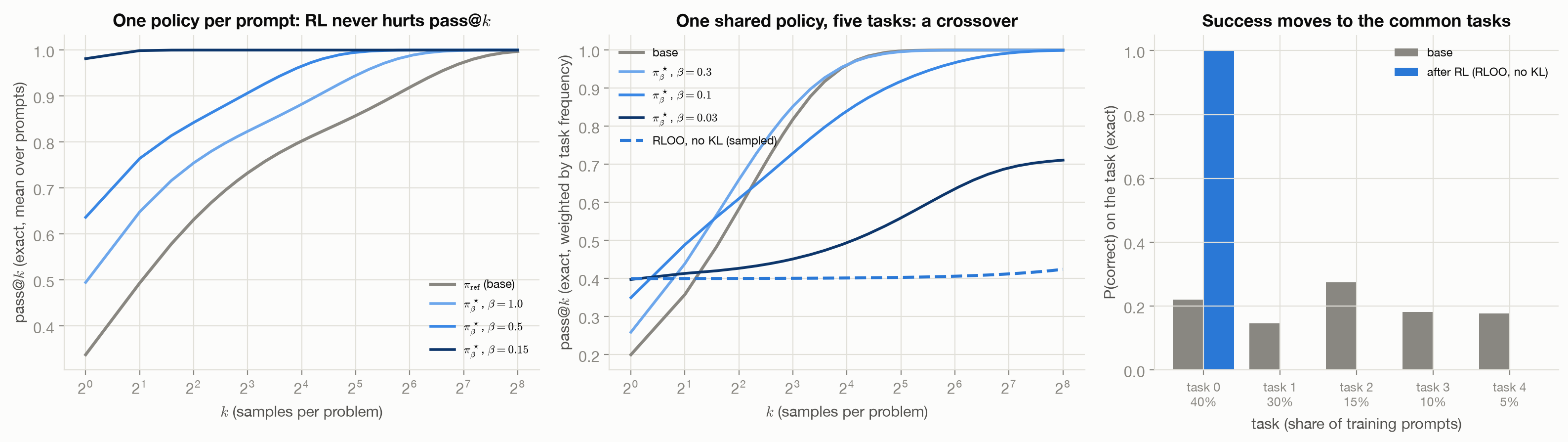
The toy cannot say which mechanism operates in real models: shared parameters, a narrowing of the reasoning strategies a model will try, or the KL-free, long optimization of recent recipes. What it pins down is the logical structure of the question. A pass@\(k\) crossover is evidence that RL lowered success on some problems, not merely that it sharpened the distribution on all of them.
11.2 Generalization and memorization
Chu et al. compare SFT and RL on two tasks built to test generalization: GeneralPoints, an arithmetic card game with rule variants, and V-IRL, a real-world navigation environment. Their abstract: “RL, especially when trained with an outcome-based reward, generalizes across both rule-based textual and visual variants”, while “SFT, in contrast, tends to memorize training data and struggles to generalize out-of-distribution scenarios” (Chu et al. 2025). Two qualifications travel with the result. SFT is not dispensable in their pipeline: “SFT stabilizes the model’s output format, enabling subsequent RL to achieve its performance gains” (Chu et al. 2025). And the tasks are specific environments, not general language-model training. Kirk et al. found the same direction for RLHF on text, “RLHF generalises better than SFT to new inputs, particularly as the distribution shift between train and test becomes larger” (Kirk et al. 2023). Two groups, different settings, the same direction: this is the closest the section comes to a replicated finding, with the caveat that “generalizes better” was measured on particular kinds of distribution shift.
A first-principles reading is available from the earlier chapters, and it is a reading, not a proof. SFT fits the forward KL to a fixed dataset of someone else’s responses (keeping updates stable), so it is rewarded for reproducing the dataset’s surface. RL is rewarded only for outcomes, on the model’s own samples (the first chapter), which is the DAgger remedy for imitation’s distribution shift (the LLM-as-policy chapter).
11.3 Forgetting
Shenfeld, Pari and Agrawal ask why online RL seems to forget less of a model’s prior abilities than SFT when both learn a new task to the same level. Their answer, “RL’s Razor”: forgetting is predicted by “the KL-divergence between the fine-tuned and base policy evaluated on the new task”, and “on-policy RL is implicitly biased towards KL-minimal solutions among the many that solve the new task, whereas SFT can converge to distributions arbitrarily far from the base model” (Shenfeld et al. 2025). This fits the structure of the book’s methods. An on-policy method moves probability mass among responses the current policy already produces, reweighting them, so the solution it finds is near where it started. SFT moves the policy toward whatever distribution the labels came from, however far away. The finding is recent (2025) and from one group, so it belongs with the recent claims; its mechanism is consistent with the mathematics of the earlier chapters.
11.4 Diversity collapse
The most consistently reported cost of RL is diversity. Kirk et al. found that “RLHF significantly reduces output diversity compared to SFT across a variety of measures” (Kirk et al. 2023). Korbak et al. opened their argument for KL-regularized RL with the observation that standard RL fine-tuning “leads to distribution collapse” (Korbak et al. 2022). Yue et al.’s narrowing is a version of the same thing seen through pass@\(k\).
The book has met collapse three times, and each time it had an identifiable cause. Unregularized REINFORCE collapsed onto a single correct answer while SFT kept the expert’s spread (the first chapter). Iterated hard filtering, the STaR/ReST pattern, drove the entropy among correct answers to zero, well past even \(\pi_{\text{ref}}\) restricted to correct answers (imitating a better distribution). And the reverse KL in the RL objective is mode-seeking (keeping updates stable). The mathematical fact underneath all three: the KL-regularized optimum \(\pi^\star\) keeps every response \(\pi_{\text{ref}}\) supports, in the same relative proportions within each reward level (the shared-target chapter). Collapse comes from removing the KL term, from optimizing past the point where it binds, from finite-sample feedback loops, or from a policy too constrained to represent \(\pi^\star\). It is not something the objective requires.
| Claim | Kind of evidence | Status as of October 2026 |
|---|---|---|
| Per problem, raising the success rate raises pass@\(k\) at every \(k\) | mathematical fact | settled |
| The KL-regularized optimum keeps \(\pi_{\text{ref}}\)’s support and proportions within each reward level | mathematical fact | settled |
| RL reduces output diversity relative to SFT | several groups (Kirk et al.; Korbak et al.; Yue et al.’s narrowing) | replicated |
| RL generalizes better than SFT under distribution shift | two groups, different settings (Chu et al.; Kirk et al.) | replicated, setting-dependent |
| RLVR does not expand what the base model can solve | Yue et al. vs. ProRL | contested |
| On-policy RL forgets less because it finds KL-minimal solutions | Shenfeld et al. | recent, single group |
11.5 Where full RL comes back: multi-turn and agentic RL
This section describes the field as of October 2026 and is deliberately short.
The chapter on the LLM as a policy explained why LLM post-training could drop so much of classical RL: deterministic transitions, a single reward at the end, a bandit over responses. Every one of those properties fails for an agent. When a model calls tools, browses, runs code or talks to a user over several turns, the next state depends on the environment’s response, which is stochastic and outside the model’s control. Rewards arrive after many turns, and the turn that earned them may be far back. The first chapter’s third property, delayed consequences, returns at the level of turns rather than tokens, and with it the machinery of values, bootstrapping and credit assignment.
Multi-turn agents restore everything the bandit view of single responses removed: stochastic transitions, rewards delayed across decisions, and the need to estimate the value of intermediate states. Values, bootstrapping and temporal credit assignment, the classical tools of the first chapter, apply again, at the level of turns.
The literature shows that machinery coming back. ArCHer argues that “most single-turn RL methods cannot endow LLMs with the ability to intelligently seek information over multiple turns, perform credit assignment, or reason about their past actions”, and pairs an off-policy, value-based learner over whole utterances with a token-level policy inside each turn (Zhou et al. 2024): a critic again, now at the level where consequences are delayed. RefGRPO finds that agents mis-assess their own outputs after seeing environment feedback and adds a calibration bonus for their self-assessment (Zhu 2026), a link to the calibration chapter. And reward hacking takes environmental forms, such as exiting a test harness early or skipping tests in agentic coding (Baker et al. 2025).
Systems matter more here too. Generation dominates the cost of RL for language models, and agentic rollouts are longer and slower still, so practical systems decouple generation from learning and train on slightly stale samples. Noukhovitch et al. study how much off-policyness that tolerates, and find online DPO the most robust (Noukhovitch et al. 2025). This book does not cover rollout engines or weight synchronization; it is enough to know that “on-policy” in an agentic system usually means “a few versions behind”, and that the importance ratios of the chapter on stable updates are what make that workable.
11.6 Connections
- Keeping Updates Stable explains the forward- vs. reverse-KL contrast behind diversity collapse and behind the generalization and forgetting findings.
- The Shared Target, and RLHF with PPO supplies the mathematical fact that the regularized optimum does not collapse, so that collapse can be traced to what a recipe removed.
- Learning by Imitating a Better Distribution produced the clearest collapse in the book, from iterated filtering, the same self-training loop many reasoning recipes use.
- The LLM as a Policy listed which parts of classical RL LLM training could drop; the agentic section of this chapter is where they come back.