8 Policy Gradients Without a Critic
PPO-based RLHF keeps a second large network, the critic, whose only job is to supply baselines. The chapter on the LLM as a policy argued that with one reward per response the problem behaves like a contextual bandit, in which a per-token value function has little to add, and the policy-gradient chapter measured that the exact per-token critic barely beat a per-prompt baseline on the toy language. This chapter follows the methods that drew the obvious conclusion: drop the critic, sample several responses per prompt, and build the baseline from the group. That is REINFORCE with a Monte Carlo baseline, the oldest policy-gradient idea there is, and it powered the reasoning models of 2025 under the name GRPO. The second half of the chapter takes apart what GRPO’s particular choices do, one bias at a time, because each of the 2025 follow-ups (Dr. GRPO, DAPO, GSPO, CISPO) is a response to exactly one of them.
8.1 The problem
Estimate the policy gradient of the KL-regularized (or plain) reward objective with low enough variance to train on, using only the policy, a frozen reference and a reward function: no learned value model. The unifying observation of this chapter is the one the policy-gradient chapter derived: any baseline that does not depend on the response it is subtracted from leaves the gradient unbiased, and other samples for the same prompt are such a baseline. A group-normalized advantage is a Monte Carlo baseline, and a group whose rewards are all equal carries exactly zero signal.
8.2 Back to basics: REINFORCE and RLOO
Ahmadian et al. revisited the simplest estimator for RLHF and argued that PPO’s machinery solves problems LLM fine-tuning does not have: strong initialization leads to “the concentration of probability mass on a few tokens at each generation step”, and with rewards only at the end, “modeling partial sequences is an unnecessary undertaking” (Ahmadian et al. 2024). They model the whole response as one action and use the leave-one-out baseline of Kool et al. (Kool et al. 2019):
\[ \nabla_\theta J \approx \frac{1}{G}\sum_{i=1}^{G}\Big[r(x,y_i) - \frac{1}{G-1}\sum_{j\ne i}r(x,y_j)\Big]\nabla_\theta\log\pi_\theta(y_i\mid x),\qquad y_1,\dots,y_G\sim\pi_\theta(\cdot\mid x). \]
They report plain REINFORCE outperforming PPO, and RLOO outperforming PPO, DPO and RAFT, on their summarization and dialogue setups (Ahmadian et al. 2024). On the toy language RLOO reaches \(\pi^\star\) as closely as PPO with a critic does (the shared-target chapter’s signature figure) at a fraction of the machinery.
| Signal | scalar reward per response (KL folded into the reward in RLHF use) |
| Samples from (\(q\)) | \(\pi_\theta\): \(G\) fresh samples per prompt (on-policy) |
| Per-sample weight (\(w\)) | \(r_i\) minus the mean reward of the other \(G-1\) samples |
| Stability | the KL-shaped reward; no clip needed in the original |
| Credit granularity | sequence level |
| Models in memory | policy, reference, reward |
| Targets | the KL-regularized objective; \(\pi^\star\) |
| Classical lineage | REINFORCE (Williams 1992) with a Monte Carlo leave-one-out baseline |
ReMax uses a different free baseline: the reward of the greedy response. It exploits the three properties of RLHF the LLM-as-policy chapter quoted (fast simulation, deterministic transitions, trajectory-level rewards), sets \(b(x) = r(x,\bar y)\) with \(\bar y\) the greedily decoded response, and reports about 46% GPU-memory savings over PPO for a 7B model by dropping the value model (Li et al. 2023). The greedy reward does not depend on the sampled response, so the estimator stays unbiased; whether it is a good baseline depends on how representative the greedy response is.
| Signal | scalar reward per response |
| Samples from (\(q\)) | \(\pi_\theta\): one sampled response per prompt, plus one greedy decode |
| Per-sample weight (\(w\)) | \(r(x,y) - r(x,\bar y_{\text{greedy}})\) |
| Stability | KL to the reference in the reward |
| Credit granularity | sequence level |
| Models in memory | policy, reference, reward |
| Targets | the KL-regularized objective |
| Classical lineage | REINFORCE with the reward of a greedy rollout as baseline: self-critical sequence training (Rennie et al. 2017) |
8.3 GRPO
Group Relative Policy Optimization combines a group baseline with PPO’s trust region (Shao et al. 2024). For each prompt it samples \(G\) outputs from \(\pi_{\text{old}}\) and maximizes
\[ \frac{1}{G}\sum_{i=1}^{G}\frac{1}{|o_i|}\sum_{t=1}^{|o_i|}\Big\{\min\big[\rho_{i,t}\hat A_{i,t},\ \mathrm{clip}(\rho_{i,t},1-\epsilon,1+\epsilon)\hat A_{i,t}\big] - \beta\,\mathbb{D}_{\mathrm{KL}}[\pi_\theta\|\pi_{\text{ref}}]\Big\}, \qquad \hat A_{i,t} = \frac{r_i - \mathrm{mean}(\mathbf r)}{\mathrm{std}(\mathbf r)}, \] with the per-token KL estimated by \(k_3 = \frac{\pi_{\text{ref}}}{\pi_\theta} - \log\frac{\pi_{\text{ref}}}{\pi_\theta} - 1\) and placed in the loss.
Every ingredient is from earlier chapters: the group mean is a Monte Carlo baseline (policy gradients), the clip is PPO’s trust region and the \(k_3\) term is Schulman’s estimator (keeping updates stable). DeepSeekMath used \(G = 64\) samples per question and \(\beta = 0.04\) (Shao et al. 2024, sec. 4.2). GRPO is the RL algorithm of DeepSeek-R1-Zero, trained from a base model with rule-based accuracy and format rewards and no SFT, and of the reasoning stages of DeepSeek-R1 (DeepSeek-AI 2025).
| Signal | scalar reward per response, often verifiable |
| Samples from (\(q\)) | \(\pi_{\text{old}}\): \(G\) responses per prompt |
| Per-sample weight (\(w\)) | group-normalized advantage \((r_i - \bar r)/\mathrm{std}(\mathbf r)\), broadcast to every token, times the clipped-ratio factor, divided by the response’s length |
| Stability | PPO-style clip; KL to \(\pi_{\text{ref}}\) in the loss, via \(k_3\) |
| Credit granularity | sequence-level advantage broadcast to all tokens |
| Models in memory | policy, reference (no critic; no reward model if the reward is verifiable) |
| Targets | approximately the KL-regularized objective; with \(k_3\) in the loss the regularizer is effectively the forward KL, so not exactly \(\pi^\star\) |
| Classical lineage | REINFORCE with a Monte Carlo baseline + PPO’s trust region |
A group-normalized advantage is the Monte Carlo baseline of the policy-gradient chapter, estimated from \(G\) extra samples instead of a learned critic, and then rescaled. Everything new in GRPO is in the rescaling and the aggregation, and those are exactly what the 2025 papers took apart.
8.4 What the group statistics do
Figure 8.1 measures three consequences of computing the baseline from the group.
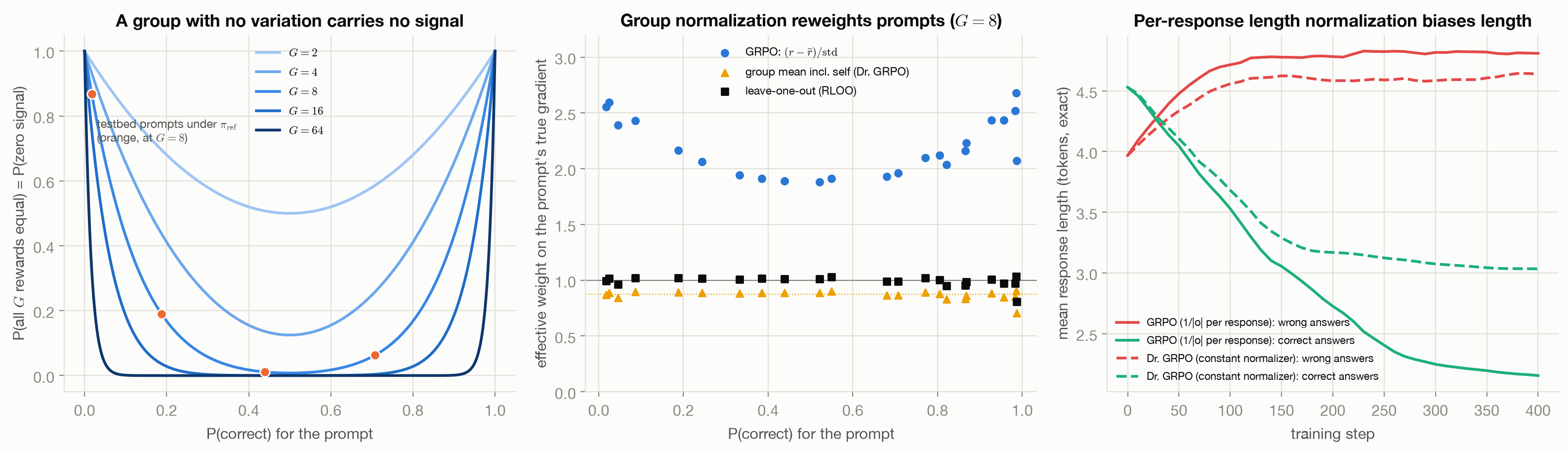
No variation, no signal. With 0/1 rewards a group of \(G\) samples is uninformative with probability \(p^G + (1-p)^G\). At \(G = 8\) that is 87% for the toy language’s hard prompt (success rate 0.02), 6% for its easiest one (0.71) and 1% for a medium one (0.44) (left panel). This is the slow start of the hard prompt in the first chapter, now as a formula. Larger groups help, which is one reason DeepSeekMath used 64.
Standard-deviation normalization reweights prompts. Dividing by the group’s reward standard deviation is not a variance-reduction trick that leaves the expected gradient alone: it multiplies each prompt’s gradient by a factor that depends on the prompt. The middle panel measures that factor. For RLOO it is 1 for every prompt (unbiased); for GRPO it ranges from about 1.9 for prompts near 50% success to about 2.7 near 0% or 100%, so the hardest and easiest prompts get up to 40% more weight. (It saturates instead of growing like \(1/\mathrm{std}\), because at the extremes most groups have no variation at all and contribute nothing.) Liu et al. identify this “question-level difficulty bias”: “questions with lower standard deviations (e.g., those that are too easy or too hard…)” receive “higher weights during policy updates” (Liu et al. 2025). It also changes the effective KL strength: GRPO’s KL term is not divided by the standard deviation, so normalizing the advantages weakens the regularization relative to the reward, and on the toy language the same GRPO runs without the division end about half as far from \(\pi^\star\) (0.49 nats instead of 1.08; the shared-target chapter).
Per-response length normalization biases length. The \(1/|o_i|\) in GRPO’s objective divides each response’s summed per-token loss by its own length. For a positive advantage, a short response gets a larger per-token push than a long one with the same advantage; for a negative advantage, a long response is penalized less per token. Liu et al. describe the consequence: GRPO gives “greater gradient updates for shorter responses” among correct ones while “longer responses are penalized less” among incorrect ones (Liu et al. 2025). The right panel runs GRPO on a variable-length version of the toy language, where length is never rewarded (the testbed appendix). With per-response normalization, correct answers shrink from about 4.5 tokens to 2.2, and wrong answers grow from 4.0 to 4.8. Swapping in a constant normalizer while keeping everything else (including the standard-deviation division) gives 2.6 and 4.6; Dr. GRPO, which also drops the division and is the run plotted, gives 3.0 and 4.6. In this toy the larger effect is on the correct answers; Liu et al. report the wrong answers’ length “growing wildly” in real long chain-of-thought training, and that a constant normalizer substantially reduces it (Liu et al. 2025).
8.5 The 2025 fixes, one bias each
Dr. GRPO removes both normalizations: “we propose to simply remove the \(\frac{1}{|o_i|}\) and std normalization terms” (Liu et al. 2025), dividing instead by a constant such as the generation budget. What remains is REINFORCE with the group-mean baseline and PPO’s clip: an unbiased (up to the \((G-1)/G\) factor of including each sample in its own baseline) policy gradient. The paper also reports that DeepSeek-V3-Base already produces self-reflection before any RL, a caution against attributing such behaviors to RL alone.
| Signal | scalar reward per response |
| Samples from (\(q\)) | \(\pi_{\text{old}}\): \(G\) responses per prompt |
| Per-sample weight (\(w\)) | \(r_i - \bar r\) (no std division), clipped-ratio factor, constant normalizer |
| Stability | PPO-style clip |
| Credit granularity | sequence level |
| Models in memory | policy (+ reference if a KL term is used) |
| Targets | the reward objective, without GRPO’s difficulty and length reweighting |
| Classical lineage | REINFORCE with a Monte Carlo baseline + PPO clip |
DAPO makes four changes, each aimed at one problem (Yu et al. 2025). Clip-Higher decouples the clip bounds (\(\epsilon_{\text{low}} = 0.2\), \(\epsilon_{\text{high}} = 0.28\)), because the upper bound “restricts the probability increase of low-probability ‘exploration’ tokens”, which collapses entropy. Dynamic sampling filters out groups in which “all outputs receive the same reward”, which have zero advantage and only shrink the effective batch: the left panel of Figure 8.1 is how often that happens. Token-level policy-gradient loss aggregates over all tokens in the batch instead of averaging per response first, so that long responses are not underweighted, the length issue of the right panel. Overlong reward shaping replaces the hard penalty for truncated responses with a graduated one. DAPO also removes the KL term, arguing that in long chain-of-thought training “the model distribution can diverge significantly from the initial model, thus this restriction is not necessary” (Yu et al. 2025). It reports 50 points on AIME 2024 with Qwen2.5-32B, against 47 for DeepSeek-R1-Zero-Qwen-32B with half the training steps.
| Signal | verifiable reward per response, with overlong shaping |
| Samples from (\(q\)) | \(\pi_{\text{old}}\), keeping only groups with non-zero reward variance (dynamic sampling) |
| Per-sample weight (\(w\)) | group-normalized advantage, clipped-ratio factor with \(\epsilon_{\text{high}} > \epsilon_{\text{low}}\), token-level aggregation |
| Stability | asymmetric clip; no KL term |
| Credit granularity | sequence-level advantage, token-level aggregation |
| Models in memory | policy only (+ verifier) |
| Targets | the reward objective itself, without a KL anchor |
| Classical lineage | REINFORCE with a Monte Carlo baseline + an asymmetric trust region |
GSPO moves the importance ratio and the clip from the token to the sequence. Zheng et al. argue that GRPO’s token-level ratios are “ill-posed”: importance sampling corrects a distribution only when averaged over many samples from it, while GRPO applies a single-sample ratio to each token, and the resulting noise accumulates over long responses (Zheng et al. 2025). GSPO uses the length-normalized sequence ratio \(s_i(\theta) = \big(\pi_\theta(y_i\mid x)/\pi_{\text{old}}(y_i\mid x)\big)^{1/|y_i|}\), clipped at the sequence level, with the group-normalized advantage. The same unit of credit now appears in the reward, the advantage, the ratio and the clip. Its clip range is correspondingly two orders of magnitude smaller (about \(3\times10^{-4}\) and \(4\times10^{-4}\), against 0.2 and 0.27 for its token-level GRPO baseline), and the authors report that it stabilizes mixture-of-experts training without GRPO’s “Routing Replay” (Zheng et al. 2025).
| Signal | scalar reward per response |
| Samples from (\(q\)) | \(\pi_{\text{old}}\): \(G\) responses per prompt |
| Per-sample weight (\(w\)) | group-normalized advantage times a clipped sequence-level ratio \(s_i(\theta)\) |
| Stability | sequence-level clip |
| Credit granularity | sequence level, throughout |
| Models in memory | policy (+ reference if KL is used) |
| Targets | the reward objective, with a sequence-level trust region |
| Classical lineage | importance-sampled policy gradient with a trust region on the whole action (the bandit view) |
CISPO keeps every token’s gradient and clips its weight instead. The MiniMax-M1 team observed that rare “reflective” tokens such as “However”, “Recheck”, “Wait” and “Aha” start with low probability, get large ratios after the first update, and are then clipped out of the gradient by PPO and GRPO for the rest of the iteration (MiniMax 2025). CISPO’s objective is \(\frac{1}{\sum_i|o_i|}\sum_i\sum_t \mathrm{sg}(\hat r_{i,t})\,\hat A_{i,t}\log\pi_\theta(o_{i,t}\mid\cdot)\) with \(\hat r = \mathrm{clip}(r, 1-\epsilon_{\text{low}}^{IS}, 1+\epsilon_{\text{high}}^{IS})\) and the stop-gradient \(\mathrm{sg}\). In this book’s terms CISPO is literally the \((q, w)\) form: \(q\) is \(\pi_{\text{old}}\), and \(w\) is the advantage times a clipped importance weight that is never zeroed. The authors report a 2× speedup over DAPO in a controlled comparison (MiniMax 2025).
| Signal | scalar reward per response |
| Samples from (\(q\)) | \(\pi_{\text{old}}\) |
| Per-sample weight (\(w\)) | per token: \(\mathrm{sg}(\mathrm{clip}(\rho_t))\cdot\hat A\): a bounded importance weight, never zero |
| Stability | clipping of the importance weight (not of the update); token-level aggregation |
| Credit granularity | sequence-level advantage, token-level weights |
| Models in memory | policy (+ reference if KL is used) |
| Targets | the reward objective |
| Classical lineage | truncated importance sampling, as in IMPALA’s V-trace off-policy correction (Espeholt et al. 2018), on a REINFORCE gradient |
8.6 Interpretation
Read in sequence, the 2025 papers converge on something close to the textbook estimator. Dr. GRPO removes GRPO’s normalizations, DAPO drops the KL term and aggregates per token, GSPO puts the whole trust region at the level of the response, CISPO turns the clip into a bounded importance weight. What remains is REINFORCE with a group baseline, a trust region at some granularity, and a set of data-side practices (filter uninformative groups, keep exploration alive). The critic did not come back, because with one reward per response a group of samples is a cheap, unbiased estimate of exactly what the critic was there to estimate.
What this costs is the per-token credit a critic could in principle provide (the LLM-as-policy chapter), and samples: \(G\) responses per prompt, most of them wasted on prompts that are too easy or too hard. And several of the choices change the target, not only the variance: standard-deviation normalization reweights prompts, per-response normalization biases length, and \(k_3\) in the loss regularizes a different divergence. Those are the details to check when two “GRPO” results disagree.
8.7 Connections
- Policy Gradients derived why a leave-one-out baseline is unbiased and measured when baselines actually reduce variance; this chapter shows what GRPO’s rescaling adds on top.
- Keeping Updates Stable supplied the clip that DAPO, GSPO and CISPO each modify, and the analysis showing that GRPO’s \(k_3\)-in-the-loss changes which divergence is regularized.
- The Shared Target, and RLHF with PPO placed these methods on the routes to \(\pi^\star\): RLOO and GRPO with the KL in the reward reach it, GRPO as published does not.
- What RL Actually Does to a Model asks what these methods change in a pretrained model, the debate that GRPO-trained reasoning models started.