2 Labels
The previous chapter asked which examples a model sees. This one asks what those examples say. A label is not the truth. It is what an annotator, a log or a rule recorded, and it can be wrong in ways that depend on the class. A model trained on labels learns the labels, errors included, so the questions are what a given kind of error does to the learned model, and when the wrong labels can be found.
2.1 The problem
Write \(y\) for the true class and \(\tilde y\) for the recorded one. A model fit to recorded labels by a proper loss estimates \(P(\tilde y = 1 \mid x)\), not the clean posterior \(\eta(x) = P(y = 1 \mid x)\) under the target distribution. In the language of the four levers, noisy labels make the training distribution’s conditional \(q(\tilde y \mid x)\) differ from \(p(y \mid x)\), which is the same kind of damage that selection on \(y\) does (The Data-Generating Process). What remains to work out is what that difference looks like, and whether it moves the decisions the model makes.
2.2 Assumptions
- Class-conditional noise. Each label is flipped independently, with a probability that depends on its true class but not on \(x\). This is the assumption confident learning makes (Northcutt et al. 2019, sec. 2). Write \(\rho_0 = P(\tilde y = 1 \mid y = 0)\) and \(\rho_1 = P(\tilde y = 0 \mid y = 1)\), with \(\rho_0 + \rho_1 < 1\). If the flip probability depends on \(x\) (annotators err more on hard cases), the formula below holds only pointwise, with rates that vary over the input space, and the boundary can move anywhere.
- Binary classes. The multiclass case replaces the two rates by a matrix of transition probabilities; the reasoning is the same.
- The model is flexible enough to estimate the posterior of what it is trained on.
2.3 Derivation or demonstration
By total probability, the recorded label is 1 when a true 1 survives or a true 0 flips:
\[ P(\tilde y = 1 \mid x) = (1 - \rho_1)\,\eta(x) + \rho_0\,\big(1 - \eta(x)\big) = \rho_0 + (1 - \rho_0 - \rho_1)\,\eta(x). \]
The learned posterior is an affine function of the clean one: shrunk toward the middle and shifted. A classifier that thresholds it at 1/2 therefore thresholds \(\eta\) elsewhere.
A model fit to labels with flip rates \(\rho_0, \rho_1\) learns \(\rho_0 + (1 - \rho_0 - \rho_1)\,\eta(x)\). Its decision rule predicts 1 when
\[ \eta(x) > \frac{1/2 - \rho_0}{1 - \rho_0 - \rho_1}. \]
With symmetric noise, \(\rho_0 = \rho_1\), the threshold is 1/2: the decisions of the clean Bayes classifier survive, though the probabilities are miscalibrated. With asymmetric noise the boundary moves, and the clean risk rises above the Bayes risk at any sample size.
Demonstration on T1. With 400,000 draws from the tabular testbed, the frequency of \(\tilde y = 1\) within narrow bins of \(\eta\) matches the formula in every bin, for both \((\rho_0, \rho_1) = (0.2, 0.2)\) and \((0.1, 0.3)\). An isotonic regression of the noisy labels on the model’s score (a flexible fit that assumes only monotonicity) crosses 1/2 within 0.25 of the predicted point, measured on the score (log-odds) scale. For the asymmetric case, that point is \(\eta = 0.67\), and the clean risk of the resulting rule is 0.278 against a Bayes risk of 0.251 (tests/test_labels.py::test_class_conditional_noise_moves_the_learned_boundary).
Labels that are measurements behave more kindly. If a regression target is recorded with zero-mean noise independent of \(x\), the conditional mean that squared error estimates is unchanged, and only the variance grows. Losses that are robust to heavy-tailed or outlying labels are derived in loss-functions-lab.
Finding label errors. Confident learning estimates which examples are mislabeled from out-of-sample predicted probabilities, obtained by cross-validation (Northcutt et al. 2019, sec. 3.1). For each class \(j\), the threshold \(t_j\) is the average predicted probability of class \(j\) among examples labeled \(j\). An example labeled \(i\) is counted under class \(j\) when its predicted probability of \(j\) is at least \(t_j\) (the most probable such class, if several qualify). The counts form the confident joint, and the examples counted off its diagonal are the estimated label errors (the paper’s “CL method 2”). tests/test_labels.py::test_confident_joint_flags_exactly_the_off_diagonal_examples checks the implementation on a case small enough to work by hand.
| Changes | Labels: flags examples whose given label disagrees confidently with an out-of-sample model, to drop or relabel |
| Assumption | Class-conditional noise (flips independent of \(x\) given the true class); out-of-sample probabilities that rank examples well; classes that overlap little |
| What it does to the learned function | If the flagged examples really are flips, removing them moves the learned posterior back toward \(\eta(x)\) and the boundary back to the clean one |
| Which models care | Every model trained on the cleaned labels; the detector itself needs calibrated-enough probabilities |
| Fit on | Out-of-sample predictions (cross-validation), never the model’s own training fit |
| Failure modes | Overlapping classes: genuine ambiguity looks like noise (precision near the noise rate); flips near the boundary are missed; noise that depends on \(x\) breaks the assumption |
| Alternatives | Repeated annotation and adjudication; noise-robust losses (loss-functions-lab); modeling the noise rates explicitly |
| Checked by | tests/test_labels.py::test_confident_learning_precision_depends_on_separability |
sklearn.model_selection.cross_val_predict(model, X, y, cv=4, method="predict_proba") produces the out-of-sample probabilities confident learning needs. The paper uses four folds unless otherwise specified (Northcutt et al. 2019, sec. 5). In scikit-learn 1.9, LogisticRegression is L2-regularized by default (C=1.0); C=np.inf gives the unpenalized fit used here.
2.4 What it does to the learned model
Noise changes the target the model aims at, not just the variance of its estimate, so it does not average out. Symmetric noise is the forgiving case for decisions and the unforgiving one for probabilities: the ranking of examples and the boundary survive, but every probability is pulled toward the middle. A model used to set prices, triage risk or combine with a prior then uses the wrong numbers. Asymmetric noise moves the boundary itself, in favor of the class that is mislabeled less often: with \(\rho_1 > \rho_0\), fewer examples are predicted to be class 1.
Cleaning the labels pulls the other lever back: if the flagged examples are the flipped ones, removing them restores \(\eta\). Whether they are depends on something the noise rates do not show.
2.5 Failure modes
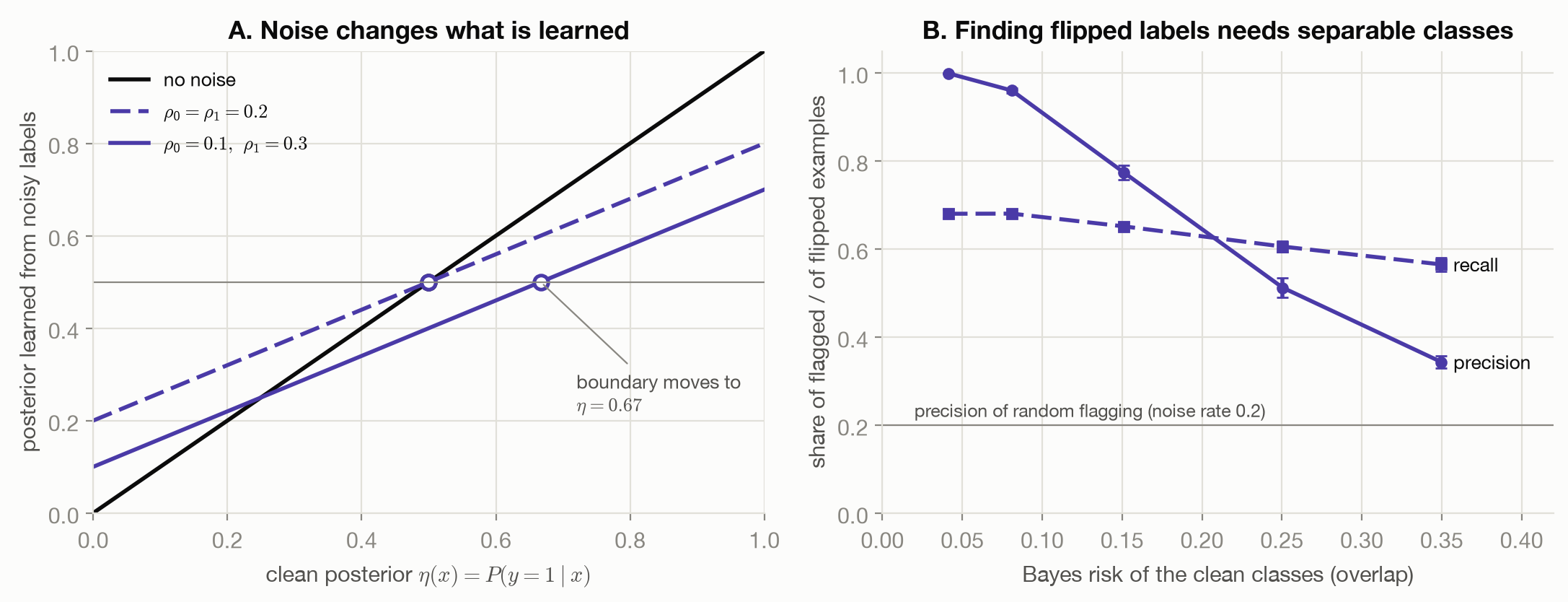
The main failure is in the detector, not the noise model. Confident learning cannot tell an injected flip from a correct label on an example whose true class is itself uncertain. On T1 with 20% symmetric flips (Figure 2.1, panel B), its precision falls from 0.999 when the clean classes overlap little (Bayes risk 0.04) to 0.34 when they overlap a lot (Bayes risk 0.35). The latter is barely above the 0.20 that flagging at random would achieve. Recall stays between 0.56 and 0.68: flips of examples near the boundary look like ordinary examples and are missed at every level of overlap. In the chapter’s terms, cleaning by confident learning pulls the labels lever safely only where the data has little aleatoric uncertainty (tests/test_labels.py::test_confident_learning_precision_depends_on_separability).
Two more ways it breaks:
- Noise that depends on \(x\). Annotators confuse the hard cases, which are the ones near the boundary. That is the worst place for flips and the place the detector is weakest.
- In-sample probabilities. A model scored on its own training data has partly memorized the wrong labels and will vouch for them. Confident learning relies on out-of-sample predictions for this reason.
2.6 What the toy cannot show
T1’s noise is exactly class-conditional and its classes overlap by a known amount. Real label noise mixes systematic confusions, annotator disagreement and ambiguity that no relabeling could resolve. The figure’s separability axis is unobservable in practice, and so is the noise rate.
2.7 Connections
- The Data-Generating Process: selection on \(y\) and noisy labels both make \(q(y \mid x) \ne p(y \mid x)\).
- Data Types and Their Structure: what counts as the same example, and as an error, depends on the data type.
- Sampling and Weighting: correcting a known prior shift is the same affine reasoning, applied to class priors instead of flips.
- loss-functions-lab, Designing a New Loss: loss-based remedies for label noise, which this book does not re-derive.