The Map
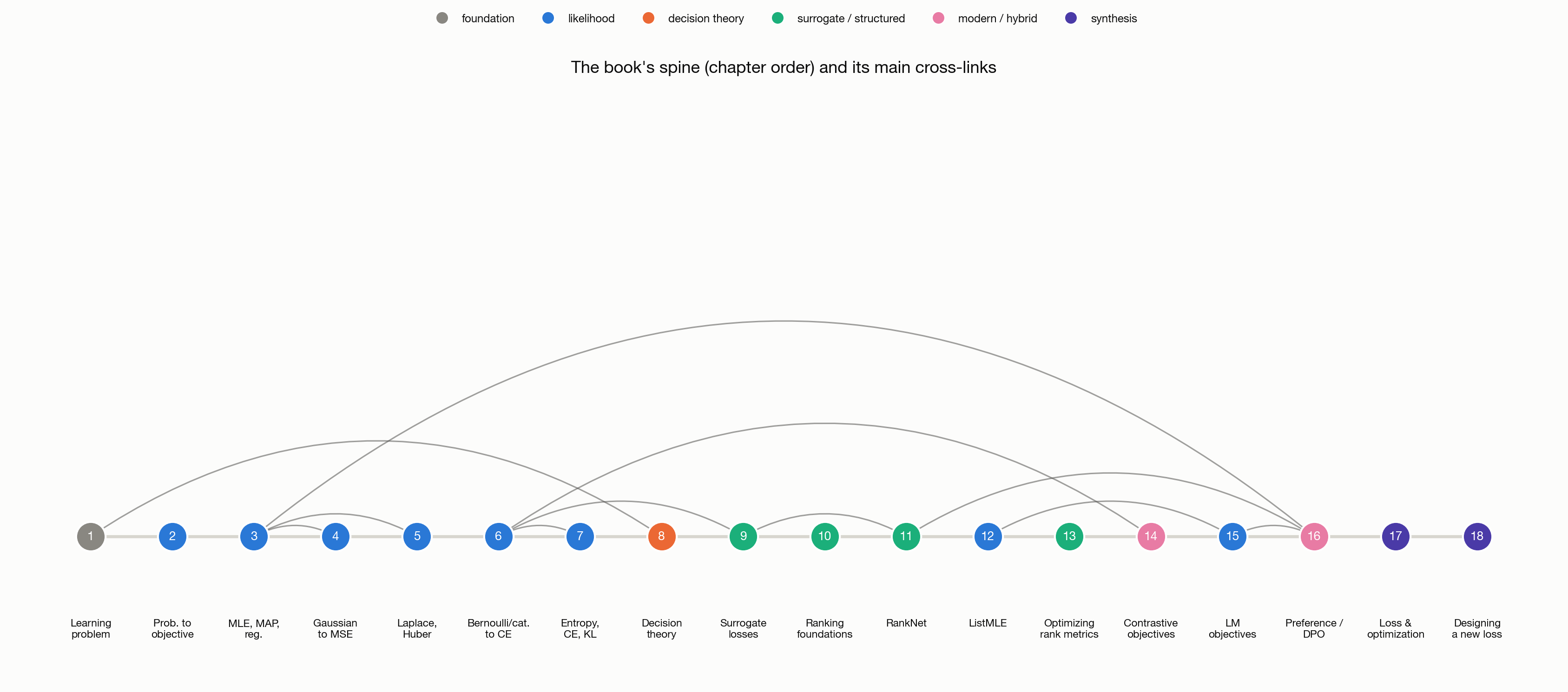
This book is one continuous argument, not eighteen independent topics, so before Chapter 1 it’s worth seeing the whole shape of it at once. Figure 1 lays out all eighteen chapters in reading order (the gray spine along the bottom) together with the most important callbacks between non-adjacent chapters (the arcs above it) — places where a later chapter reuses, reconciles, or reinterprets something derived earlier rather than introducing something new.
The five families
Every loss in this book is color-coded by where it actually comes from — the same six-label taxonomy (five shown here; heuristic/design choice and hybrid share the pink “modern / hybrid” color, since most heuristic choices in this book turn out to be one ingredient of a hybrid) that each chapter uses explicitly in its own “Origin” callout:
- Likelihood (blue) — a loss derived as the negative log-likelihood of an explicit probabilistic model: Gaussian → squared error, Laplace → absolute error, Bernoulli/categorical → cross-entropy, and — the same construction, just applied to sequences and permutations instead of single examples — ListMLE and language-model pretraining.
- Decision theory (orange) — a loss derived from naming a decision and a utility directly, with no probabilistic model as an intermediate step.
- Surrogate / structured (green) — a tractable stand-in for something that resists direct optimization: hinge for 0–1 loss, RankNet and LambdaRank for rank-position metrics.
- Modern / hybrid (pink) — objectives that combine more than one of the above, or are motivated primarily by a desired geometric or behavioral property rather than a single clean derivation: contrastive learning, DPO.
- Synthesis (purple) — the two closing chapters, which don’t introduce a new loss at all but instead connect everything derived earlier to optimization behavior and to a reusable design procedure.
Figure 1’s legend shows a sixth color, gray, for Chapter 1 alone: it sets up the vocabulary (loss, risk, empirical risk) every other chapter uses but doesn’t itself derive a loss, so it sits outside the six-label origin taxonomy entirely rather than counting as a sixth family.
Reading paths
Front to back is the intended path — each chapter leans on specific results from the ones before it, and the arcs in the figure above are easiest to appreciate having just read both of their endpoints. But the book is modular enough to enter anywhere a specific question points: arriving already knowing you want cross-entropy’s information-theoretic meaning starts at Chapter 7; arriving with a ranking problem starts at Chapter 10; arriving having just read the DPO paper and wanting the parts that weren’t spelled out starts at Chapter 16. Whatever the entry point, Chapter 18 is worth reading last regardless — it’s where the whole book’s method, not just its results, gets made explicit and reusable.