12 Listwise Ranking: ListMLE
RankNet learns from pairs, and a full ranking of \(n\) items has \(\binom{n}{2}\) of them — but decomposing a ranking into pairs throws information away. A list where every adjacent pair is barely correctly ordered and a list where the whole thing is perfectly sorted can produce very similar total pairwise loss, even though only one of them is the ranking anyone actually wanted. The alternative this chapter derives models the probability of the entire observed ordering directly, as one object, rather than as a collection of independent pairwise judgments.
12.1 The problem
Given an observed ranking (permutation) \(\pi\) of \(n\) items with scores \(s_1,\dots,s_n = f_\theta(x_1),\dots,f_\theta(x_n)\), define a loss on the whole ordering at once, rather than pair by pair.
12.2 Assumptions
Assume a generative story for how a ranking arises from scores: items are chosen one at a time, from the top down, and at each step the probability of picking a particular remaining item is proportional to the exponential of its score — exactly a softmax over whatever items are still left. This is the Plackett–Luce model (Luce 1959; Plackett 1975):
\[ P(\pi \mid s) = \prod_{k=1}^{n} \frac{\exp(s_{\pi(k)})}{\sum_{l=k}^{n} \exp(s_{\pi(l)})}, \]
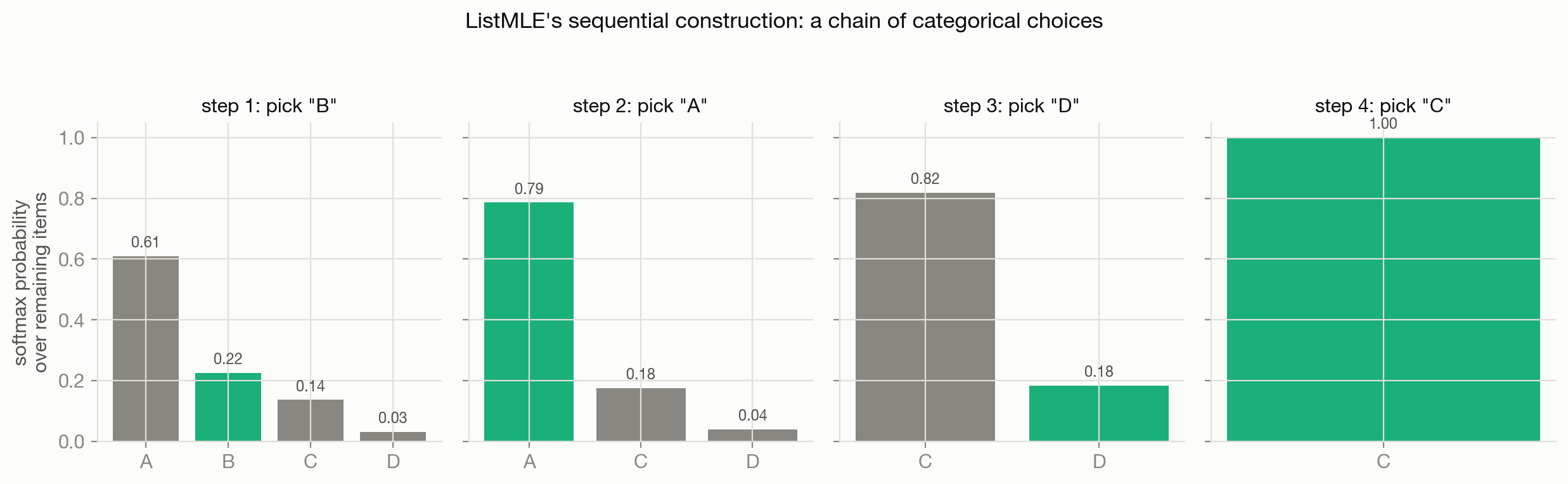
where \(\pi(k)\) is the index of the item placed at rank \(k\). Read the product term by term: the first factor is the probability the top-ranked item is chosen first, from a softmax over all \(n\) items; the second factor is the probability the second-ranked item is chosen next, from a softmax over the remaining \(n-1\) items (the top pick removed); and so on down to a single item left with probability \(1\). Nothing here assumes the choices are independent across steps — they explicitly are not, since each step’s softmax is taken over a shrinking set — only that each step’s conditional choice, given what’s already been picked, follows a softmax over what remains. This is the same categorical/softmax construction from Chapter 6, applied repeatedly to a shrinking candidate set rather than once.
12.3 Derivation
Taking the negative log of \(P(\pi\mid s)\) turns the product into a sum, by exactly the same log mechanics as every other likelihood in this book (Chapter 2):
\[ -\log P(\pi\mid s) = \sum_{k=1}^{n} \left[-s_{\pi(k)} + \log\sum_{l=k}^n \exp(s_{\pi(l)})\right]. \]
Each summand is precisely Chapter 6’s categorical cross-entropy — \(-\log\) of a softmax probability — evaluated on the softmax over whatever items remain at step \(k\). ListMLE (Xia et al. 2008) is exactly this: the negative log-likelihood of the Plackett–Luce model, evaluated at the observed ground-truth permutation.
Figure 12.1 walks through this for four toy items with fixed scores and an observed ranking that is not simply sorted by score (so the loss is genuinely nonzero): at each step, the bar chart shows the softmax over whatever items remain, with the item the observed ranking actually picks next highlighted. The full permutation’s likelihood is the product of the four highlighted probabilities; the ListMLE loss is minus the sum of their logs.
12.4 The resulting objective
\[ \ell_{\mathrm{ListMLE}}(\theta) = -\log P(\pi \mid s) = \sum_{k=1}^{n} \left[-s_{\pi(k)} + \log\sum_{l=k}^n \exp(s_{\pi(l)})\right] \]
ListMLE is the NLL of a genuine generative model of rankings (Plackett–Luce) — not a new kind of construction invented for lists. It is, more precisely, a chain of Chapter 6’s categorical cross-entropy, one link per rank position, each conditioned on the positions already resolved.
12.5 Interpretation
Minimizing \(\ell_{\mathrm{ListMLE}}\) pushes the model’s scores toward assigning high sequential “pick probability” to the observed ranking at every step — the item that should be ranked first should look like the clear top choice among all \(n\) items; the item that should be ranked second should look like the clear top choice among the remaining \(n-1\); and so on. Because every step still uses a full softmax, mistakes at any position affect the gradient for every item still under consideration at that step, not just the two items directly compared — a structurally richer training signal than the pairwise comparisons of Chapter 11.
12.6 Behavior and edge cases
Early steps in the product involve softmaxes over more items and dominate the top of the ranking, which is usually where mistakes matter most anyway — a useful, if accidental, alignment with how ranking metrics like NDCG weight position. Ties or near-ties among lower-ranked items contribute softmax terms with several comparably-sized probabilities, so the loss is comparatively insensitive to their exact relative order — arguably appropriate, since real annotators are usually least reliable about the tail of a ranking too.
12.7 Limitations
The Plackett–Luce model has its own baked-in assumption, sometimes called independence of irrelevant alternatives: the relative probability of picking item \(i\) over item \(j\) at any step doesn’t depend on which other items are also present. Real human ranking behavior can violate this (the presence of a third, similar option can change a stated preference between the first two) — worth knowing this is a modeling choice, not a law. Computationally, ListMLE is \(O(n)\) softmax evaluations per list (via a single cumulative-sum trick over the sorted scores) rather than the \(n!\) permutations a brute-force likelihood would require — tractable, but each step still costs a full softmax over the remaining candidates, more than RankNet’s simple pairwise comparisons.
12.8 Optimization implications
Each step is a softmax cross-entropy — smooth and well-understood, with the same gradient-saturation behavior described in Chapter 6 (confidently wrong picks are corrected hardest). Summing \(n\) such terms per list means the per-example computational and memory cost scales with list length, worth knowing when choosing between pairwise and listwise approaches for large candidate sets; see Chapter 17 for the general comparison.
12.9 Connections
- Chapter 11 is the pairwise alternative this chapter’s listwise construction is contrasted against directly.
- Chapter 6 supplies the categorical cross-entropy this chapter chains together, step by step.
- Chapter 13 continues the theme of optimizing a listwise objective, this time made explicitly aware of a ranking metric.
- Chapter 15’s autoregressive language-model factorization is, structurally, the same idea as this chapter’s Plackett–Luce construction — a chain of categorical choices, each conditioned on what came before — applied to token sequences instead of rankings.