13 Optimizing Ranking Metrics Directly
RankNet and ListMLE are both principled — genuine negative log-likelihoods of genuine probabilistic models — and both share a blind spot Chapter 11 already flagged: neither one knows that position 1 matters more than position 40. A pair deep in the tail of a ranking and a pair at the very top contribute to RankNet’s loss on exactly equal footing; ListMLE’s early softmax steps happen to weight the top of the list more, but only as a side effect of the construction, not because anything in the loss was told to care about metric position. This chapter closes that gap directly, using an idea that sidesteps Chapter 10’s differentiability problem rather than solving it.
13.1 The problem
Take a pairwise or listwise surrogate that already trains reasonably well, and make it explicitly sensitive to the ranking metric actually being reported — NDCG, say — without needing that metric to be differentiable at all.
13.2 The LambdaRank idea
Recall from Chapter 11 that RankNet’s loss for a pair produces a gradient — a pull on \(s_i\) — of magnitude \(\sigma(-\Delta)\) where \(\Delta = s_i - s_j\). LambdaRank (Burges 2010) keeps that pull’s direction and shape but rescales its magnitude by one more factor:
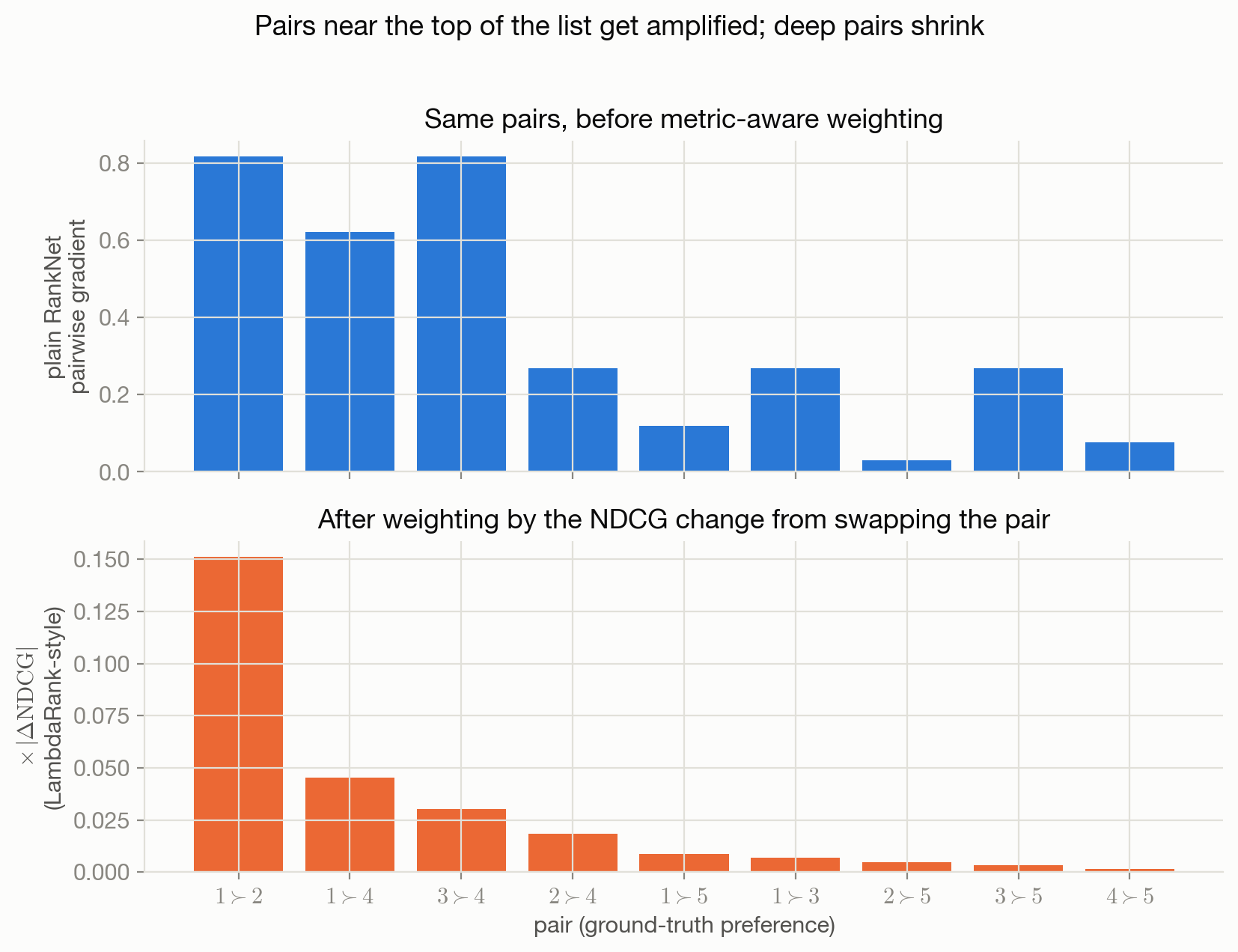
\[ \lambda_{ij} = \sigma(-\Delta) \cdot \big|\Delta\,\mathrm{NDCG}_{ij}\big|, \]
where \(\Delta\,\mathrm{NDCG}_{ij}\) is the change in the whole list’s NDCG that would result from swapping items \(i\) and \(j\)’s positions in the current ranking, holding everything else fixed. This number is easy to compute exactly — it only requires evaluating NDCG twice, once for the current order and once with two items swapped — even though NDCG itself cannot be differentiated with respect to the scores.
This is a genuinely different move from everything else in this book so far. Every other chapter defined a scalar loss and then took its gradient. LambdaRank instead defines the gradient directly — the \(\lambda_{ij}\) values are treated as the per-pair force used to update scores, without ever being obtained by differentiating a single scalar objective. (A scalar loss with this gradient can be constructed after the fact, but the practical algorithm doesn’t need it — it works directly with the forces.) LambdaMART is the same idea plugged into gradient-boosted trees, where each boosting round fits a tree to these \(\lambda\) values instead of to a residual.
Figure 13.1 makes the effect concrete on a small 5-item list with a partly-misordered current ranking: the plain RankNet gradient magnitude for each ground-truth-preferred pair is compared against the same pair’s gradient after multiplying by \(|\Delta\mathrm{NDCG}|\). Pairs whose swap would change the top of the ranking are amplified sharply relative to pairs deep in the list whose swap barely moves NDCG at all — exactly the position-sensitivity that plain RankNet lacks.
13.3 Other strategies, briefly
LambdaRank’s “define the gradient, skip the differentiable loss” trick is not the only way to attack a metric more directly. A different family of approaches makes the sort operation itself approximately differentiable — replacing the hard \(\mathrm{argsort}\) with a smooth relaxation (a soft permutation) that can be differentiated end-to-end, trading off exactness for a usable gradient everywhere rather than a metric-weighted gradient at observed pairs only. Both strategies solve the same underlying problem from Chapter 10 — a metric with no usable gradient — by different means, and both are examples of the same higher-level move: give up on differentiating the true target and construct something differentiable, or at least optimizable, that tracks it.
13.4 The reasoning pattern, made explicit
Chapter 10 named a five-step pattern this chapter has now walked through once, concretely:
- What ranking property is actually wanted? (Position-sensitive accuracy, captured by NDCG.)
- What metric captures it? (NDCG itself.)
- Why can’t it be optimized directly? (Piecewise-constant in the scores — Chapter 10’s figure.)
- What surrogate captures the desired behavior anyway? (RankNet’s pairwise gradient, reweighted by \(|\Delta\mathrm{NDCG}|\).)
- What assumptions does the surrogate introduce? (That a locally-defined swap gradient, accumulated pairwise, is a reasonable stand-in for globally optimizing the metric — a heuristic connection, not a proof of equivalence, though it works well in practice.)
Chapter 18 reuses this exact five-question pattern as a general-purpose tool for an arbitrary new problem, not just ranking — this chapter is its concrete rehearsal.
13.5 Connections
- Chapter 10 posed the metric/loss/surrogate problem this chapter resolves for NDCG specifically.
- Chapter 11 supplies the pairwise gradient LambdaRank reweights rather than replaces.
- Chapter 12 is the contrast case: a listwise likelihood with no explicit metric-awareness at all.
- Chapter 18 explicitly reuses this chapter’s five-step reasoning pattern as one of the tools in its general recipe.