2 The Map
Modern AI is easiest to misread as a single ladder: classical ML at the bottom, deep learning in the middle, LLMs at the top, everything else a footnote. That framing collapses the moment you look at an actual system. A production recommender combines supervised ranking, matrix factorization, sequence models, bandit exploration, and causal evaluation of logged data. A retrieval-augmented LLM product combines dense embeddings, approximate nearest-neighbor search, a generative model, an evaluation pipeline, and a safety layer. None of these are one technique wearing different hats — they are distinct problem framings that happen to compose.
This chapter is the whole landscape in one page: the eighteen framings covered by the eighteen chapters that follow it — this map is the book’s nineteenth chapter, not a nineteenth framing — grouped into six questions a system’s design answers, with the concrete concepts that let one chapter’s ideas solve another chapter’s problem. Read it first, then use it as the index whenever a later chapter references a neighbor — it’s the map key, not just an introduction.
2.1 Five questions that locate almost any method
Before naming the framings, it helps to have the axes they vary along. Most of what you’ll meet in this book can be placed by asking:
- What is observed, and what is hidden? Supervised learning observes everything relevant (inputs and labels); latent-variable models assume something important — a cluster identity, a topic, a user’s true preference — is never directly seen.
- Is the goal prediction, generation, decision-making, or causal estimation? Predicting tomorrow’s demand, generating a plausible product description, deciding which ad to show, and estimating whether a discount caused a purchase are four different mathematical problems that happen to use overlapping machinery.
- Are labels available, weak, delayed, biased, or missing entirely? This single question is why supervised learning, self-supervised representation learning, weak supervision, and reinforcement learning all exist as separate fields rather than one.
- Is uncertainty central or incidental? A spam filter can be usefully wrong sometimes. A model deciding whether to page an on-call engineer, or a self-driving system deciding whether to brake, cannot treat its confidence as an afterthought.
- Does the method need to survive contact with a running system? Latency budgets, feedback loops, privacy constraints, and monitoring are not add-ons bolted onto a model after the fact — they shape which method is usable at all.
2.2 The eighteen framings, in six groups
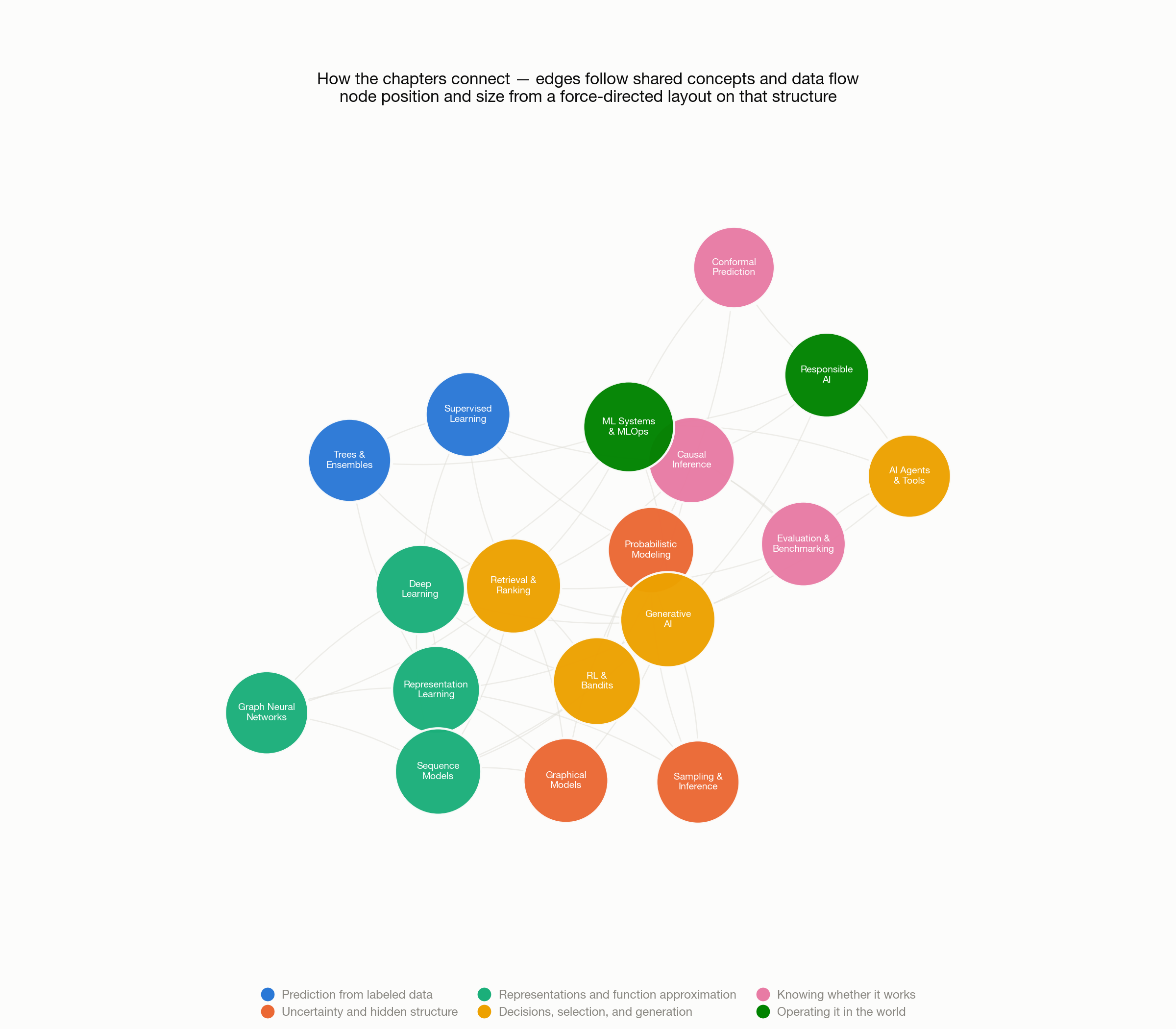
scripts/figures/fig_landscape_network.py: it builds a graph from the edge list below and lets a spring layout (Fruchterman-Reingold) find node positions, rather than hand-placing boxes.
1. Prediction from labeled data
Supervised Learning answers the oldest question in the field: given labeled examples, how do we predict the right output for a new input? Trees, Ensembles, and Tabular ML is supervised learning specialized for structured, tabular data — still the default choice for a large share of real production systems, deep learning’s dominance in research notwithstanding.
3. Representations and function approximation
Representation Learning asks what compressed or transformed view of raw data makes everything downstream easier. Deep Learning Foundations scales that idea with layered, differentiable models trained by gradient descent — less a single application and more a modeling toolkit reused across almost every other chapter. Sequence, Time-Series, and State Models adds order and memory: how the past constrains the present. Graph Neural Networks adds relational structure: how a node’s neighbors constrain what it means.
4. Decisions, selection, and generation
Reinforcement Learning and Bandits turns prediction into action under feedback: what should an agent do to maximize reward over time, when its own choices change what it observes next? Information Retrieval, Ranking, and Recommenders selects and orders candidates from a large space. Generative AI and Foundation Models produces new content directly — text, images, code — by sampling from a learned distribution over what plausible data looks like. AI Agents, Tool Use, and Multi-Agent Systems wraps a generative model in a loop that plans, calls tools, and revises — the newest and least settled framing here.
5. Knowing whether it works
Evaluation and Benchmarking is the methodology that every other chapter depends on and few of them state explicitly: what makes a metric trustworthy, and when does it stop matching the thing you actually care about? Causal Inference and Experimentation asks a sharper version of the same question — not just “does the model look good?” but “did our intervention cause the outcome we wanted?” Conformal Prediction gives a model-agnostic way to know how much to trust any single prediction, with a guarantee that holds even when the underlying model doesn’t.
6. Operating it in the world
ML Systems and MLOps is what turns a notebook result into something reliable, observable, and cheap enough to run in production. Responsible, Private, and Robust AI is the set of constraints — fairness, privacy, robustness, safety — that decide whether a system should run the way it technically could.
2.3 Why the boundaries are porous
A handful of ideas keep reappearing under different names because they are genuinely the same idea:
- Regularization is a prior. Ridge and lasso penalties are the MAP estimate under a Gaussian or Laplace prior — supervised learning and probabilistic modeling doing the same optimization from two vocabularies.
- A recommender’s embeddings are latent variables. Matrix factorization in retrieval and ranking is structurally identical to the latent factors in graphical models.
- Generation is sampling. A diffusion model, a VAE decoder, and an autoregressive LLM are all, mechanically, ways to sample from a learned distribution — which is why generative AI leans so heavily on ideas from sampling and representation learning.
- An agent’s tool call is a decision. The control loop in AI agents — observe, decide, act, observe the result — is the same loop reinforcement learning has formalized for decades, now with a language model as the policy.
- Prediction is not intervention. The single most common production mistake this book returns to: a model that predicts well is not the same as an action that causes the outcome you want. That gap is the entire subject of causal inference, and it quietly undermines naive uses of supervised learning, RL, and ranking alike.
Read the rest of this book with those five patterns in mind, and the map above stops being eighteen separate subjects and starts being one subject looked at from eighteen angles.