20 Responsible, Private, and Robust AI
Every other chapter in this book asks whether a model works. This one asks what happens when it does — because a model that is accurate on average can still be unfair to a subgroup, leak information about the people in its training data, be trivially fooled by an adversary, or confidently produce harmful output at scale. Responsible AI is not one property a model either has or lacks. It’s a family of distinct concerns — fairness, privacy, interpretability, robustness, security, and alignment — each with its own failure modes, its own metrics, and often its own tradeoffs against the others and against raw accuracy. The unifying discipline across all of them is the same: name the people the system affects, name the specific way it could harm them, decide how you’d measure that, and decide what you’d do about it. Treating “is this AI responsible” as a single yes/no question, or a single metric to hit, is itself usually the first mistake — a system can score well on demographic parity and still discriminate through a correlated proxy; a system can satisfy differential privacy and still leak information in effect through model behavior; a system can pass a static robustness test and still be defeated by an adversary who’s read the paper.
20.1 Fairness
Bias enters a machine learning system in several distinct ways, and telling them apart matters because they call for different fixes. Historical bias exists in the world before any data is collected — if a hiring process has historically favored one group, training data drawn from past hiring decisions encodes that pattern regardless of how carefully the data is collected. Representation bias comes from who is included in the data at all — a dataset with too few examples of a subgroup will produce a model that’s simply less accurate for that subgroup, not necessarily biased in a discriminatory direction, just under-trained on it. Measurement bias comes from proxies that don’t mean the same thing across groups — using arrest records as a proxy for criminal behavior, when policing intensity itself varies by neighborhood and demographic, bakes in a systematic distortion that has nothing to do with the underlying behavior being measured. These compound into allocation harms (who gets a loan, a job interview, a diagnosis) and quality-of-service gaps (a speech recognizer that works worse for one accent, a face detector that works worse for one skin tone) — the first is about who receives a resource, the second is about whether the system works equally well for everyone who uses it, and a system can be guilty of either without the other.
Fairness metrics formalize different, and importantly, mutually incompatible notions of what “fair” means:
- Demographic parity: \(P(\hat Y = 1 \mid A = 0) = P(\hat Y = 1 \mid A = 1)\) — the positive prediction rate is equal across groups, regardless of the true outcome. This is the right target when the base rates themselves are considered unjust or a downstream effect of the bias you’re trying to correct for.
- Equalized odds: true positive rate and false positive rate are both equal across groups, conditional on the true label. This is the right target when you want the model’s errors, not just its output rate, to be distributed equally.
- Equal opportunity: a relaxation of equalized odds that only requires equal true positive rates — useful when false positives matter less than making sure qualified members of every group are found at equal rates.
- Calibration by group: within each group, a predicted probability of \(p\) should correspond to an actual positive rate of \(p\) — the model’s confidence should mean the same thing regardless of group membership.
A foundational and often underappreciated result is that, except in degenerate cases, demographic parity, equalized odds, and calibration by group cannot all be satisfied simultaneously when the base rate of the outcome differs across groups — which is common, since base rates differing across groups is frequently the very thing that motivated looking at fairness in the first place. Choosing a fairness metric is therefore not a technical detail to defer to an engineer; it’s a value judgment about what kind of equality matters for the specific decision being made, and it needs to be made explicitly, with the people affected and the nature of the harm in mind, not defaulted to whichever metric a fairness toolkit happens to report first.
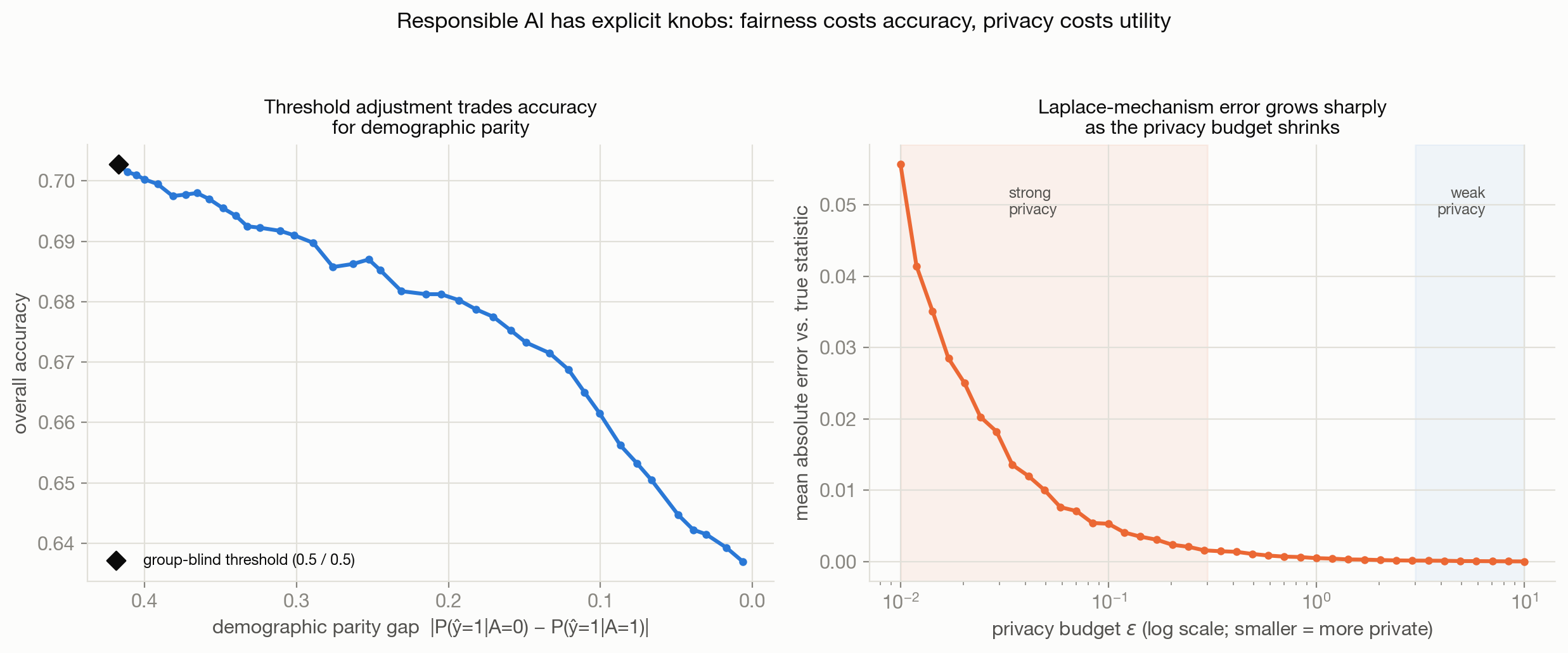
Figure 20.1 (left panel) makes the fairness/accuracy tradeoff concrete on a synthetic biased dataset, where a sensitive attribute correlates both with a predictive feature and with the label directly (a stand-in for historical bias). Starting from a group-blind decision threshold, adjusting the classification threshold per group traces out a frontier: closing the demographic parity gap costs overall accuracy, and the curve shows how much — this is not a hypothetical tension, it’s a direct, measurable one for any dataset where the sensitive attribute carries real predictive signal correlated with historical outcomes.
20.2 Privacy
Privacy techniques form a rough hierarchy from weakest to strongest guarantee. Data minimization — collecting and retaining only what’s needed — and anonymization or aggregation — stripping direct identifiers, reporting only group statistics — are the cheapest and most common defenses, but both are famously breakable: removing a name and an address doesn’t prevent re-identification when enough auxiliary quasi-identifiers (zip code, birth date, gender) remain, a fact demonstrated repeatedly on supposedly anonymized datasets by cross-referencing them against other public records.
Differential privacy (DP) is the formal answer to that weakness. A randomized mechanism \(M\) is \(\varepsilon\)-differentially private if for any two datasets \(D, D'\) differing in a single record, and any output set \(S\),
\[ P(M(D) \in S) \leq e^{\varepsilon} \, P(M(D') \in S). \]
In words: whether or not any single individual’s data is in the dataset changes the probability of any observable output by at most a factor of \(e^\varepsilon\). This gives a precise, worst-case guarantee that holds regardless of what the adversary already knows or does with the output — unlike anonymization, whose protection depends entirely on what auxiliary information happens to be available to an attacker. Small \(\varepsilon\) means strong privacy (the mechanism’s output is nearly indistinguishable whether or not you’re in the data) and larger \(\varepsilon\) means weaker privacy (closer to releasing the true, un-noised statistic). The standard way to achieve this for a numeric query is to add noise calibrated to the query’s sensitivity — how much the query’s output can change from adding or removing one record — for example the Laplace mechanism adds noise drawn from \(\text{Laplace}(0, \Delta / \varepsilon)\), where \(\Delta\) is the query’s sensitivity, directly to the true answer.
Figure 20.1 (right panel) runs exactly this on a simple bounded mean query: as \(\varepsilon\) shrinks (stronger privacy, less signal allowed to leak), the noise needed to satisfy the definition grows, and the mean absolute error against the true statistic rises sharply — this is the privacy/utility tradeoff made concrete and quantitative rather than asserted. The curve also shows the shape of the tradeoff clearly: well-chosen small \(\varepsilon\) costs real accuracy, but the marginal cost of tightening privacy further keeps growing, while a large \(\varepsilon\) quickly stops buying any meaningful privacy at all — there’s a real inflection point, not a smooth linear tradeoff, and choosing \(\varepsilon\) in practice means picking a point deliberately rather than defaulting to a library’s example value.
A crucial property that makes DP practical for real systems is composition: the privacy loss of releasing multiple DP-protected statistics from overlapping or the same data accumulates (roughly, the \(\varepsilon\)’s add, with tighter accounting available for more careful analyses), which is exactly the mathematical structure needed to reason about a privacy budget across an entire system rather than only a single query. A system making thousands of DP queries against the same underlying dataset needs to track cumulative privacy loss deliberately, or the aggregate guarantee silently degrades to nothing even if each individual query looked private in isolation.
Beyond central DP applied to a single trusted data holder, federated learning trains a shared model across decentralized data without centralizing the raw data itself — only model updates (gradients or weight deltas) leave each device — which reduces but does not eliminate leakage risk, since gradients themselves can sometimes be inverted to recover information about the underlying data; it’s often combined with DP or secure aggregation (a cryptographic protocol ensuring the server only ever sees the sum of client updates, never any individual one) to close that gap. On-device inference avoids the privacy question for inference entirely by never sending user data off the device in the first place, though this doesn’t protect data used to train the shared model.
20.3 Interpretability
Interpretability methods trade off scope, faithfulness, and cost. Coefficients and feature importance from an inherently interpretable model (linear/logistic regression, a shallow tree) are the cheapest and most faithful explanation available, precisely because the explanation is the model, but they only exist for models simple enough to be interpretable by construction. SHAP (Shapley additive explanations) and LIME (local interpretable model-agnostic explanations) both work post-hoc on any black box: SHAP attributes a prediction’s deviation from a baseline to each feature using Shapley values from cooperative game theory — the unique attribution satisfying a specific, principled set of fairness axioms about how credit should be split among features — while LIME fits a simple local surrogate model around one prediction to approximate the black box’s behavior near that point. Both are approximations to the true, usually intractable decision function, and both can be fooled or made unstable by an adversarially constructed model, which matters if the explanation is being used for anything with real stakes rather than just intuition building.
Counterfactual explanations answer a different, often more directly actionable question: not “why did the model decide this,” but “what’s the smallest change to my input that would flip the decision” — directly useful for a rejected loan applicant, less useful for auditing the model’s overall behavior. Saliency maps highlight which input regions (pixels, tokens) most influenced a prediction, standard for vision and increasingly for language models, though naive gradient-based saliency is known to be fragile and sometimes highlights regions with no real causal bearing on the output. Probing and mechanistic interpretability go a level deeper for neural networks specifically: probing trains a small auxiliary classifier on a model’s internal representations to test whether a specific concept is linearly recoverable there, while mechanistic interpretability tries to reverse-engineer the actual computational circuit a network has learned — the most ambitious and currently the most labor-intensive approach, but the only one aiming at genuinely explaining how the model computes its output rather than merely correlating inputs with outputs.
20.4 Robustness and security
A model’s accuracy on its test set says nothing about how it behaves under distribution shift — a systematic change between training and deployment conditions that isn’t adversarial, just different, and the same phenomenon covered as data drift in ML Systems and MLOps. Adversarial examples are the deliberately engineered version: small, often imperceptible perturbations to an input, specifically constructed (usually via gradients of the model’s own loss function) to flip its prediction, which demonstrate that high test accuracy and genuine robustness are not the same property at all. For language models specifically, prompt injection is the analogous attack: input (often from an untrusted source the model is asked to process, like a webpage or document) crafted to override the model’s intended instructions, a first-class security concern for any system covered in AI Agents, Tool Use, and Multi-Agent Systems where a model acts autonomously on retrieved or user-supplied content. Data poisoning attacks the training pipeline itself rather than a deployed model, injecting corrupted examples so the model that gets trained already has an exploitable weakness baked in. Model extraction attacks try to reconstruct a proprietary model’s behavior (or the model itself) purely by querying it as a black box, a risk for any model exposed through a public API. Jailbreaks are prompt-level attacks specifically aimed at bypassing a language model’s safety training rather than its factual correctness. Abuse monitoring is the operational, ongoing counterpart to all of the above — detecting misuse patterns in production traffic in real time, since no set of defenses designed before launch anticipates every attack that will actually be tried against a live system.
20.5 Safety and alignment for generative AI
Generative models introduce failure modes that don’t have a clean analogue in classical supervised learning, because the output space is open-ended rather than a fixed label set. Refusal behavior — a model declining to answer a harmful or disallowed request — has to be tuned carefully, because both directions of miscalibration are real failures: over-refusal makes a model useless for legitimate requests that merely resemble harmful ones, under-refusal defeats the point of having a safety boundary at all. Factuality (a model asserting false information confidently, commonly called hallucination) is a distinct problem from safety in the harmful- content sense, but shares the same root cause: generative models are trained to produce plausible continuations, not verified ones, and nothing in that training objective directly rewards truthfulness over fluency. Toxicity and policy compliance cover the more classical content- moderation surface — output that’s harmful, offensive, or against a platform’s stated policy, whether or not it was solicited. Reward hacking is what happens when a model optimized against a proxy reward (often a learned reward model standing in for human preference, as in RLHF) finds a way to score well on the proxy without actually satisfying the underlying intent — verbose answers that “seem” thorough to a reward model without being more correct, for instance. Human preference validation is the ongoing check that a model’s learned notion of “good” (from RLHF, DPO, or similar) actually still tracks what humans want, rather than drifting toward whatever the training process happened to make easy to optimize. Red teaming — deliberately, adversarially trying to break a model’s safety properties before and after deployment — is the operational practice that catches gaps left by all of the above, precisely because none of these properties can be fully verified by a fixed test set; a sufficiently motivated adversary explores parts of the input space that a static benchmark never will.
20.6 When to use it / what can go wrong
The single most important habit across all of these areas is refusing to treat “responsible AI” as a checkbox metric computed once before launch. Fairness metrics need to be recomputed as a model’s population and behavior drift in production, exactly like any other metric in ML Systems and MLOps. A DP guarantee only holds if the privacy budget is tracked cumulatively across every query the system ever makes against the protected data, not just the one query that was audited. A robustness evaluation against last year’s known attacks says nothing about next year’s, especially for systems (like language models behind a public API) that adversaries can iterate against directly. And an interpretability method that looks reasonable on a hand-picked example needs to be checked for faithfulness more broadly — SHAP and LIME approximations can both be systematically misleading for particular model classes and particular kinds of feature correlation.
The second habit is being explicit about which specific harm and which specific affected group a given mitigation targets, because the concerns in this chapter frequently trade off against each other, not just against accuracy: a differential privacy mechanism can worsen fairness, since adding noise disproportionately hurts accuracy for underrepresented subgroups where there was already less signal to begin with; an interpretability method that surfaces a sensitive attribute’s influence on a decision can itself become a privacy leak; and a robustness intervention hardened against one attack class can degrade accuracy or fairness for ordinary, non-adversarial inputs. There is no single scalar that captures “is this system responsible,” and any team that reduces the question to one should treat that as a sign the actual analysis — who is affected, how, and what tradeoff was chosen and why — hasn’t been done yet.
20.7 How this connects
- Evaluation and Benchmarking — fairness metrics, robustness evaluations, and safety red-teaming are all specialized evaluation methodology, subject to the same slicing, statistical power, and benchmark-validity concerns as any other model evaluation.
- Causal Inference and Experimentation — a claim that a model “causes” disparate outcomes across groups is a causal claim, and rigorous fairness audits need the same confounding-aware reasoning as any other causal question, not just an observational metric gap.
- Conformal Prediction — class-conditional (Mondrian) conformal prediction is a direct fairness tool, guaranteeing coverage per subgroup rather than letting a marginal guarantee mask worse reliability for one group.
- ML Systems and MLOps — fairness, privacy budgets, and robustness all need continuous production monitoring, using the same drift-detection and guardrail infrastructure built for ordinary model quality metrics.
- AI Agents, Tool Use, and Multi-Agent Systems — prompt injection, jailbreaks, and abuse monitoring are sharpest exactly where an agent acts autonomously on untrusted content or has access to real-world tools, making robustness a safety-critical property rather than a nice-to-have.